day 16 of our flipped out calendar opens up a new OP–1 field update: OS 1.6.0. it introduces a new amp synth engine with an included tuner, multichannel audio over usb, improved tape crossfade, count in recording, drum sample fade control, a preset randomizer, updated preset management, and midi clock over ble and some more improvements.
DECEMBER 16, 2025

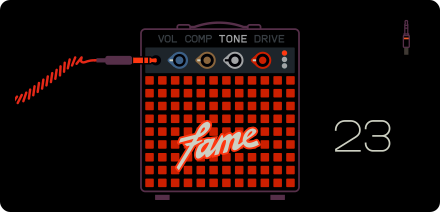
a line in for your electric guitarthe new amp synth engine lets you route any external signal, such as the line in from a guitar or the usb audio, through the filters and fx of OP–1 field, before recording to tape. amp also includes a handy tuner, so you can keep your guitars, synths, and vocal cords in tune, while recording or rehearsing.
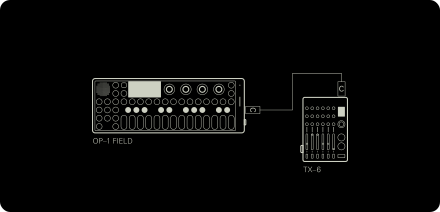
multichannel usb audiothe 1.6.0 OS update introduces the ability to send the four tape tracks as separate stereo channels over usb, in addition to the stereo mix. this significant improvement simplifies your workflow, allowing for easy recording of complete ideas directly into your daw, external mixing, or capturing your tape as individual stems without any extra configuration.
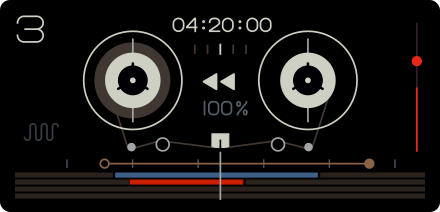
tape edits are now smoother.with the new tape crossfade, lifting and dropping clips applies a short, non destructive crossfade on both sides of the edit. this reduces clicks and pops and keeps the tape workflow intact. your audio stays unaltered, so you can move clips around as much as you like, without degrading anything.
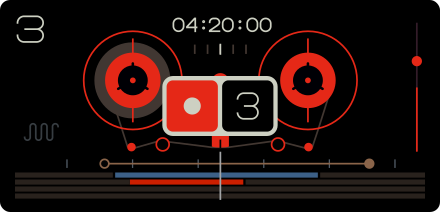
count in.you can now start recordings with a count in, giving you a brief moment to lock into the tempo before the tape begins. this is helpful when playing rhythmic parts or when layering new takes on top of existing material.
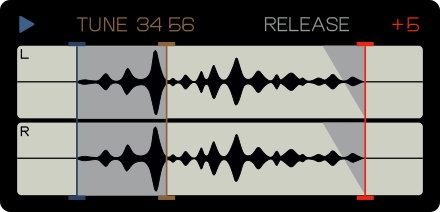
drum sampler fadethe drum sampler now lets you choose how fades behave. you can control attack, release, or both at the same time. this gives more flexibility when shaping transients, tightening hits, or fading loops in and out, while keeping all existing presets unchanged.
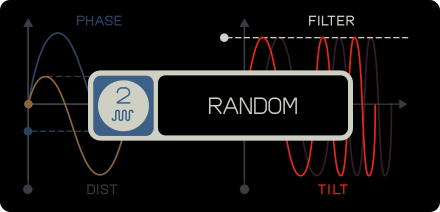
random presetrandomize any preset to generate a fresh starting point. an easy way to explore the rich sound of OP–1 field, discover unexpected combinations, and move beyond familiar patches. each randomization keeps the preset structure intact but reassigns values within it.
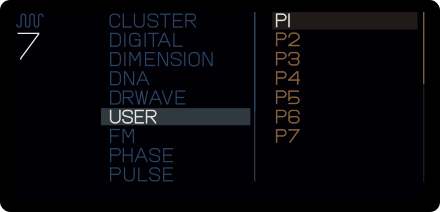
more flexible organising of presets manage your user presets and folders directly on OP–1 field. you can move, rename, and delete them as needed. this feature is ideal for organizing larger sound libraries, making it easy to manage numerous custom patches or prepare curated sets for live performance.
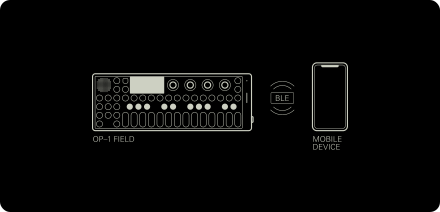
midi clock can now be sent over bluetooth le.this lets you sync external gear wirelessly, without any extra cables around your setup. devices that support ble sync, like TX–6, OP–XY and OP–Z, can follow OP–1 field’s tempo in real time.
learn all about the new firmware in the latest episode of midnight operations with product owner jonas. watch episode here.


december 4, 2025

this little ting has more to offer than you might think. you aren't limited to what comes out of the box. simply connect it to a computer to import your own samples and tailor the effects. let's take a look at how to do all this. but first: update to the latest firmware or you won't be able to do any of it.
how to update EP–2350 ting
samplesyou are not limited to the 4 samples that ting comes with, you can easily replace them with your own. the only limitation is the 1 MB of ting disk space available for 4 user samples that must be wav files (mono or stereo, 8/16/24-bit or 32-bit float and up to 96 KHz)
add your samples - essentialsthe simplest way to add your own samples is to upload files named 1.wav, 2.wav, 3.wav, and 4.wav. each file you add will override the built in sample in that slot / number. if you only upload, say, 1.wav, the other three slots will still play the built in samples. if you don’t add any files at all, all four built in samples will play as usual.
how to replace the samples on EP–2350 ting
add your samples - advancedthis is a bit more demanding, but it unlocks more of ting’s possibilities and gives you a glimpse of what you can do with a bit of code. ting uses a small text file called a config.json. this keeps track of which samples to load and how to use them, etc. use this file to map your samples to slots 0-3. you can now name your audio files whatever you like. copy the samples and the config.json to the ting disk, and you’re done.
we’ve put together a json file and four new samples that you can download and try out.
we’ve put together a json file and four new samples that you can download and try out.

samples and json file
effectsas mentioned above, ting can read instructions from a json file. this file does much more than just tell ting which samples to play. it defines an entire fx chain, a sequence of individual effects, whose combined result becomes one of ting’s four effects. within that chain, you can reorder, swap, or redesign effects, change how you interact with them, and adjust the parameters for every effect in the chain. you can also choose whether samples should be “colored” by routing them through specific parts of the chain.
if you feel like diving into building your own fx chains, it’s worth starting from the examples below and tweaking a few parameters to see how ting behave.
this stuff can get pretty complicated, so if you want to go further and build your own effects, the online guide is a good place to start.
how to customize EP–2350 ting with json
if you happen to break the json code for some reason and the device freezes, don't panic. simply connect to computer and hold green + white buttons during startup to access and fix the file.
if you get a “not enough disk space” message even if the ting disk looks empty, try re-formatting tingdisk:
connect ting via USB-C, wait for “tingdisk” to appear, right-click on the disk, choose “erase disk” on mac OS or “format” on windows 10/11, file system should be FAT.
if you get a “not enough disk space” message even if the ting disk looks empty, try re-formatting tingdisk:
connect ting via USB-C, wait for “tingdisk” to appear, right-click on the disk, choose “erase disk” on mac OS or “format” on windows 10/11, file system should be FAT.

riddim n' ting jamaica
OCTOBER 31, 2025

our hearts are with everyone affected by the recent hurricane across jamaica and neighboring islands.
as some of you may already know, we’ve been working on two new EP units with a close connection to reggae, dancehall and sound system culture. we made our first trip to jamaica early spring this year where we met with artists and producers featured on EP–40 riddim and we just got back from our
second, pre-launch jamaica trip.
this has been a passion project for us, one that started seven years ago with
the idea of a reggae pocket operator, ended up as the EP–40 riddim and
EP–2350 ting, both to be released next week. over the course of this project we’ve met with artists from all over the world, incredible people who helped
us lay the foundations for how these units should sound and work.
as some of you may already know, we’ve been working on two new EP units with a close connection to reggae, dancehall and sound system culture. we made our first trip to jamaica early spring this year where we met with artists and producers featured on EP–40 riddim and we just got back from our
second, pre-launch jamaica trip.
this has been a passion project for us, one that started seven years ago with
the idea of a reggae pocket operator, ended up as the EP–40 riddim and
EP–2350 ting, both to be released next week. over the course of this project we’ve met with artists from all over the world, incredible people who helped
us lay the foundations for how these units should sound and work.

denzil williams junior and denzil williams senior, who both became
instrumental in connecting us with artists and producers in jamaica.

everything was done in close collaboration with swedish artists and dear friends
marcus price, patrik arve and rodrigo pencheff, all of whom are true reggae,
dancehall and soundsystem aficionados.

at rockers international, founded by jamaican dub pioneer
augustus pablo and is now run by his son addis pablo.

at alpha boys school, where we hosted presentations and workshops along
with etana and king jammy, 2 of the 13 collaborating artists on the EP–40.

marcus price and clevie at clevie’s studio

lisa hyper on the EP–40

at judgement yard jamming with sizzla

oct 15, at our pre-release party at legendary weddy weddy wednesdays.
live ep-40 gig featuring major artists, including turbulence and junior reed.
OCTOBER 23, 2025

the new york-based and pittsburgh-raised singer, songwriter, and producer is fresh off of a multi-festival and sold-out European headline tour run this summer. we had the opportunity to meet with him at the way out west festival in gothenburg, sweden and chat about his upcoming project, The Spirit Still Remains (Purgatory), out on Oct. 31. The Spirit Still Remains (Purgatory) exemplifies Montell’s dj gummy bear moniker as an exercise in creating a sandbox of limitless creativity, freedom, and experimentation. Purgatory brings those musical experiments to the forefront, allowing Montell to experiment with electronic, house, ambient and experimental soundscapes through the dj gummy bear character, free of any imposed expectations on what ‘Montell Fish’ music is meant to sound like.
after releasing his debut album jamie back in 2022, montell’s been on the rise with the ep her love still haunts me like a ghost, containing one of his hit singles “hotel,” and his most recent project charlotte. where we find tracks like “scream my name” and “who did you touch?”.
entering a new season of artistry, montell’s been exploring more electronic, house, ambient and experimental soundscapes through his alter ego “dj gummybear”, focusing on the creative freedom of music and art.
after releasing his debut album jamie back in 2022, montell’s been on the rise with the ep her love still haunts me like a ghost, containing one of his hit singles “hotel,” and his most recent project charlotte. where we find tracks like “scream my name” and “who did you touch?”.
entering a new season of artistry, montell’s been exploring more electronic, house, ambient and experimental soundscapes through his alter ego “dj gummybear”, focusing on the creative freedom of music and art.

if someone had never heard your music before, how would you describe “montell fish”?
hard to say haha. i would say it’s a blend to start off. vocally, i love rnb, probably one of my favorite genres. i love ambient music, and hip-hop for drums and loops. i also love indie and folk music for guitar influence. it’s somewhere in between a few genres. if you’re into some guitar rnb indie kind of hip-hop stuff, you might be into it.
hard to say haha. i would say it’s a blend to start off. vocally, i love rnb, probably one of my favorite genres. i love ambient music, and hip-hop for drums and loops. i also love indie and folk music for guitar influence. it’s somewhere in between a few genres. if you’re into some guitar rnb indie kind of hip-hop stuff, you might be into it.

you’ve said dj gummy bear gives you creative freedom, where did that alter ego come from, and what doors has it opened musically?
dj gummybear is a space for me to be more experimental, to try ideas i might not be ready to explore under montell fish. it’s kind of like a sandbox where i can study and test sounds, then release them without overthinking. he’s his own character with his own world, how he looks, how the shows feel, and how the sound is more electronic and production-focused. i imagine dj gummybear doing club sets, dj nights, and more spontaneous performances, while montell fish is more of a live band, an emotional experience. with dj gummybear, i’m less concerned about numbers or expectations and more focused on making stuff that’s fun and free.
the name came to me really fast, and that was intentional. i wanted something playful and light, not overthought. i like gummybears, and the name just felt like it matched the energy of the project. there’s something i enjoy about writing songs with serious emotion or spiritual weight under a name that sounds like candy. the contrast is what makes it interesting.
when i create as montell fish, there's often pressure to make something that resonates with a lot of people. fans sometimes get attached to past versions of me, and it’s tough to navigate that. with dj gummybear, there’s none of that, it feels like starting fresh. like when you find a new artist and you’re not comparing them to anything, they just are who they are. that freedom allows me to take more risks and step outside the traditional structures i might stick to with montell fish.
gummybear has also helped me fall back in love with music. he’s a fan, a collector, a student of sound. through him, i dig into genres, study production, and get inspired in new ways. and once i’ve learned what i need, i come back to montell fish with a clearer vision. i still care about legacy and making meaningful work, but gummybear reminds me that joy and experimentation are part of
that too.
dj gummybear is a space for me to be more experimental, to try ideas i might not be ready to explore under montell fish. it’s kind of like a sandbox where i can study and test sounds, then release them without overthinking. he’s his own character with his own world, how he looks, how the shows feel, and how the sound is more electronic and production-focused. i imagine dj gummybear doing club sets, dj nights, and more spontaneous performances, while montell fish is more of a live band, an emotional experience. with dj gummybear, i’m less concerned about numbers or expectations and more focused on making stuff that’s fun and free.
the name came to me really fast, and that was intentional. i wanted something playful and light, not overthought. i like gummybears, and the name just felt like it matched the energy of the project. there’s something i enjoy about writing songs with serious emotion or spiritual weight under a name that sounds like candy. the contrast is what makes it interesting.
when i create as montell fish, there's often pressure to make something that resonates with a lot of people. fans sometimes get attached to past versions of me, and it’s tough to navigate that. with dj gummybear, there’s none of that, it feels like starting fresh. like when you find a new artist and you’re not comparing them to anything, they just are who they are. that freedom allows me to take more risks and step outside the traditional structures i might stick to with montell fish.
gummybear has also helped me fall back in love with music. he’s a fan, a collector, a student of sound. through him, i dig into genres, study production, and get inspired in new ways. and once i’ve learned what i need, i come back to montell fish with a clearer vision. i still care about legacy and making meaningful work, but gummybear reminds me that joy and experimentation are part of
that too.

what drew you toward house, ambient, and experimental sounds in this season of your artistry?
when i was 17, i was really into soundcloud and youtube, pages like majestic casual and soulection. that era had a lot of experimental r&b and house blends that weren’t fully electronic or fully house, and that in-between space really pulled me in. back when i was following traditional christianity, i’d play ambient music while praying, i could listen for hours. i think that soaked into my production over time. i’m drawn to slow, distinct sounds that feel like stepping into another world.
when i was 17, i was really into soundcloud and youtube, pages like majestic casual and soulection. that era had a lot of experimental r&b and house blends that weren’t fully electronic or fully house, and that in-between space really pulled me in. back when i was following traditional christianity, i’d play ambient music while praying, i could listen for hours. i think that soaked into my production over time. i’m drawn to slow, distinct sounds that feel like stepping into another world.

what inspires you at the moment?
right now, i’m inspired by the idea of being in between. i’m working on a project called purgatory, based on the christian belief of a waiting place between heaven and hell. i love liminal spaces, that tension of not knowing, not being fully here or there. movies like eternal sunshine or inception capture that dreamlike, unresolved feeling, those in-between moments really speak to me.
right now, i’m inspired by the idea of being in between. i’m working on a project called purgatory, based on the christian belief of a waiting place between heaven and hell. i love liminal spaces, that tension of not knowing, not being fully here or there. movies like eternal sunshine or inception capture that dreamlike, unresolved feeling, those in-between moments really speak to me.

what instruments or gear do you find yourself reaching for the most when you're making music? any go-to tools that always spark inspiration?
yeah, lately i’ve been reaching for a lot of fm sounds. i love r&b, and the way the yamaha dx7 was used in the 80s and 90s has always stuck with me, there’s a real beauty in that kind of synthesis. i’ve also been using my OP-1 a lot. i’ll load in sounds i like and sketch ideas on it. it started as a home setup thing, but over time i got comfortable enough to bring it on stage. now i run it through a chroma console by hologram, manipulate the sound, and loop it live.
my process changes, but it usually starts with melody. i’m a melody-first person, it’s what gets stuck in your head and brings you back to a song. i’ll start with piano or guitar, then add drums, and build from there. this year i’ve been diving deeper into synths, just messing around until something clicks. lyrics come second. honestly, i love instrumental music. sometimes i just want to say one phrase, like in “you make me feel loved,” and let that carry the whole track. it’s about creating a feeling with as little as possible. i love space in music, letting the sound breathe.
to go along with the spirit still remains (purgatory), montell’s also put together a custom sample pack. built from the same ambient and experimental textures found throughout the project, the pack offers a glimpse into the sounds and tones shaping this new chapter. it’s a snapshot of the world he’s creating, freeform, atmospheric, and open to exploration.
how to transfer montell fish’s sample pack to your OP–1 field:
yeah, lately i’ve been reaching for a lot of fm sounds. i love r&b, and the way the yamaha dx7 was used in the 80s and 90s has always stuck with me, there’s a real beauty in that kind of synthesis. i’ve also been using my OP-1 a lot. i’ll load in sounds i like and sketch ideas on it. it started as a home setup thing, but over time i got comfortable enough to bring it on stage. now i run it through a chroma console by hologram, manipulate the sound, and loop it live.
my process changes, but it usually starts with melody. i’m a melody-first person, it’s what gets stuck in your head and brings you back to a song. i’ll start with piano or guitar, then add drums, and build from there. this year i’ve been diving deeper into synths, just messing around until something clicks. lyrics come second. honestly, i love instrumental music. sometimes i just want to say one phrase, like in “you make me feel loved,” and let that carry the whole track. it’s about creating a feeling with as little as possible. i love space in music, letting the sound breathe.
to go along with the spirit still remains (purgatory), montell’s also put together a custom sample pack. built from the same ambient and experimental textures found throughout the project, the pack offers a glimpse into the sounds and tones shaping this new chapter. it’s a snapshot of the world he’s creating, freeform, atmospheric, and open to exploration.
how to transfer montell fish’s sample pack to your OP–1 field:
- download the sample pack.
- connect your OP–1 field to your computer via USB C.
- open the field kit app. (mac only)
- drag and drop the sample pack files into the drum folder.
- eject your OP–1 field safely from your computer.
- your new samples are now ready to use.
OCTOBER 16, 2025

with OS 1.1.0, your OP–XY becomes an even more powerful sampler. this update introduces a new sample slicer, perfect for chopping breaks, melodic sequences, or vocals. it offers three slicing modes for flexible, precise control over how you cut and play back your sounds:
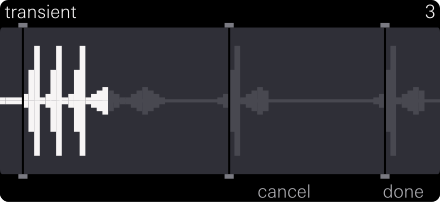
transient-based slicing:OP–XY automatically detects peaks and hits in your sample and slices them—ideal for drums, percussion, or anything with sharp attacks.
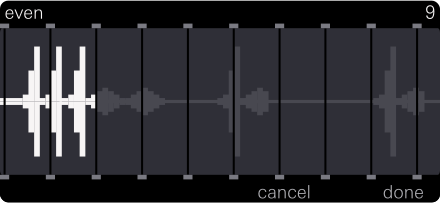
time-based slicing:divides your sample into equal sections, great for loops, rhythmic material, or when you want perfectly even slices across the entire recording.
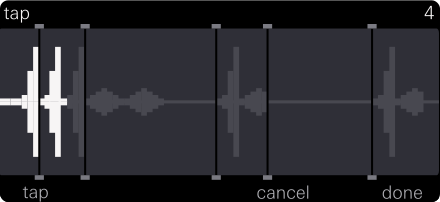
manual tap:tap your own slice points to create custom rhythms and break your sample exactly where you want it.
to go along with the slicer, we also added parameter lockability to the drum sampler.
to go along with the slicer, we also added parameter lockability to the drum sampler.
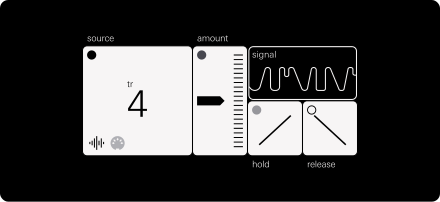
duck:with the new update there’s a new lfo, duck. use duck to quickly add sidechain compression to any instrument track. it takes audio or note data from one track and modulates the volume of another. use it to create space for your kicks in your bass or to add movement to pads.

this update also brings several quality-of-life improvements for sequencing and performing. you can now define how OP–XY calculates scene length for more precise playback control. song mode has been refined to work consistently with the rest of the device, simply hold shift before pressing buttons. this allows you to continue using the musical keyboard even when in the song mode screen.
using sound link, you can now use the same sound across all patterns of a track, useful for live sets or when you want to skip presets per pattern. and finally, a much-requested feature: delayed scene switch. when performing live, queue up the next scene instead of immediately switching scenes.
using sound link, you can now use the same sound across all patterns of a track, useful for live sets or when you want to skip presets per pattern. and finally, a much-requested feature: delayed scene switch. when performing live, queue up the next scene instead of immediately switching scenes.
watch the latest midnight operations episode, where product owner jonas walks through all of the new updates.
update your OP–XY via our update utility tool
update your OP–XY via our update utility tool
you can now set your own price for the OP–XY. see our flipped-out offer here.
september 25, 2025

the australian producer, vocalist, and songwriter brux blends experimental electronic textures with groovy, immersive soundscapes, pulling you into a world of electrifying dance music. in a recent collaboration with baauer, she released her latest single ca$hed up, crafted mostly using the EP–133 K.O. II.
we recently had the chance to talk with her about the sonic world she’s built, the process behind the track, and how the EP–133 became a key part of her workflow.
we recently had the chance to talk with her about the sonic world she’s built, the process behind the track, and how the EP–133 became a key part of her workflow.

who is brux?
i think she's a version of myself that's fearless and open in expression. she's loud and lively, it's fun to be her!
tell us about your music and your inspirations:
i make bassy, groove-heavy, lively tunes and i try to always have an experimental edge in the sound design by using my collection of analog hardware. stylistically, i pull from a lot of different places - within electronic music I look up to the chemical brothers, sophie, gorillaz, the knife, air, peaches...and outside of that realm i love artists like tyler the creator, joni mitchell, björk, ryuichi sakamoto, radiohead, idles. the list goes on. at the core i'm drawn to things that are against the grain and unconventional. standing out from the pack is my motto in life.
what inspired the process of making ca$hed up?
when we made the tune back in 2024, i was 3 years into moving to new york from australia and was processing the sensory switch-up of busy life in this bustling city. it's what inspired the grittiness of the production and also of course the vocal hook. the constant grind of new yorkers is real!
i think she's a version of myself that's fearless and open in expression. she's loud and lively, it's fun to be her!
tell us about your music and your inspirations:
i make bassy, groove-heavy, lively tunes and i try to always have an experimental edge in the sound design by using my collection of analog hardware. stylistically, i pull from a lot of different places - within electronic music I look up to the chemical brothers, sophie, gorillaz, the knife, air, peaches...and outside of that realm i love artists like tyler the creator, joni mitchell, björk, ryuichi sakamoto, radiohead, idles. the list goes on. at the core i'm drawn to things that are against the grain and unconventional. standing out from the pack is my motto in life.
what inspired the process of making ca$hed up?
when we made the tune back in 2024, i was 3 years into moving to new york from australia and was processing the sensory switch-up of busy life in this bustling city. it's what inspired the grittiness of the production and also of course the vocal hook. the constant grind of new yorkers is real!

how did you and baauer meet?
we met at a show we played in brooklyn at the end of 2023 - machinedrum hosted an event where a bunch of artists dj'd b2b for hours and baauer and i played a few tunes together. from there we linked up to start having studio sessions!
how is making music with baauer different from doing it solo?
it's a lot of fun working together - we seem to get ideas out quickly and crack a lot of jokes during the process too. i also love to work solo but the social aspect of collaborating with another artist who's so laid back like baauer is a real treat.
tell us about the creative process behind the track.
baauer and i were given a studio space to use in manhattan, it was in a beautiful historic 1800s carriage house and it was a relaxed setup with lots of fun gear to use. we both have a similar process where we start by creating a drum groove and so we did just that. after creating an 8 bar groove we then figured out a melodic sample riff that was the next piece of the puzzle, and then added a bassline and finally sketched it fully out into an arrangement. both of us produce in ableton live, so it was a lot of back and forth on the one computer to keep tweaking the track. when we left the studio that day, it was just an instrumental. and it wasn't until a week or 2 after the session where i came up with the vocal hook and added it to the track. baauer and i continued to finesse the tune over the coming weeks and then i sent it over to my friend surya sen who is a london-based artist/rapper for him to record the hook to layer with mine. weeks later baauer and i were invited to dj at a popup event that mija was hosting in brooklyn and it was at that show where we tested out the tune for the first time. it hit hard and the crowd reacted well!
we met at a show we played in brooklyn at the end of 2023 - machinedrum hosted an event where a bunch of artists dj'd b2b for hours and baauer and i played a few tunes together. from there we linked up to start having studio sessions!
how is making music with baauer different from doing it solo?
it's a lot of fun working together - we seem to get ideas out quickly and crack a lot of jokes during the process too. i also love to work solo but the social aspect of collaborating with another artist who's so laid back like baauer is a real treat.
tell us about the creative process behind the track.
baauer and i were given a studio space to use in manhattan, it was in a beautiful historic 1800s carriage house and it was a relaxed setup with lots of fun gear to use. we both have a similar process where we start by creating a drum groove and so we did just that. after creating an 8 bar groove we then figured out a melodic sample riff that was the next piece of the puzzle, and then added a bassline and finally sketched it fully out into an arrangement. both of us produce in ableton live, so it was a lot of back and forth on the one computer to keep tweaking the track. when we left the studio that day, it was just an instrumental. and it wasn't until a week or 2 after the session where i came up with the vocal hook and added it to the track. baauer and i continued to finesse the tune over the coming weeks and then i sent it over to my friend surya sen who is a london-based artist/rapper for him to record the hook to layer with mine. weeks later baauer and i were invited to dj at a popup event that mija was hosting in brooklyn and it was at that show where we tested out the tune for the first time. it hit hard and the crowd reacted well!

how did the EP–133 end up in your process?
we both had never used the EP–133 sampler but immediately gravitated towards it at the start of our session and loaded various drum groove loops and single shot samples onto it. through trial and error we recorded in a bunch of sample hits and found a super unique percussive rhythm that we were instantly excited by! we built the track pretty quickly around it by then adding in a kick rhythm, bassline and chord stab that was also triggered by the EP–133.
cha$hed up is the lead single release from brux’s latest ep of the same name. you can listen to the track and check out the video below, where brux and baueer walk us through the creative process behind it.
we both had never used the EP–133 sampler but immediately gravitated towards it at the start of our session and loaded various drum groove loops and single shot samples onto it. through trial and error we recorded in a bunch of sample hits and found a super unique percussive rhythm that we were instantly excited by! we built the track pretty quickly around it by then adding in a kick rhythm, bassline and chord stab that was also triggered by the EP–133.
cha$hed up is the lead single release from brux’s latest ep of the same name. you can listen to the track and check out the video below, where brux and baueer walk us through the creative process behind it.
september 4, 2025
photos by Pao Duell
photos by Pao Duell

when swedish-american indie-pop band miike snow went on their reunion tour last year, they decided to bring the then unreleased OP–XY with them. together with love hultén, they built a custom made live rig where the OP–XY was embedded. this year, for the fourth time, the band returned to the coachella stage. with them, they brought the OP–XY and the same live rig. we sat down with our good friend and member of miike snow, pontus winnberg, to let us in on the story.

pontus winnberg, one of three members of miike snow
how did it feel to return to coachella?
this was the fourth time we’ve played at coachella, last time was 2016 so a lot of things have happened to the festival and the vibe. i really enjoyed it. it was a lot of fun and we got a really good time slot, considering that we haven't released stuff in a while. we were on at 9:30 on the biggest tent right before the prodigy. the downside was that we were overlapping with missy elliott, which I would have loved to see.
this was the fourth time we’ve played at coachella, last time was 2016 so a lot of things have happened to the festival and the vibe. i really enjoyed it. it was a lot of fun and we got a really good time slot, considering that we haven't released stuff in a while. we were on at 9:30 on the biggest tent right before the prodigy. the downside was that we were overlapping with missy elliott, which I would have loved to see.

the OP–XY rig
why did you decide to use the OP–XY for your live shows?
i was really into the OP–Z sequencer. i had long conversations with the project owner of OP–Z and OP–XY, jonas åberg, about what i felt could be done and added to the unit. there was a feature on the OP–Z, i can't remember what it was called, but it's what eventually became the brain function on the OP–XY. my interpretation of it is that it acts as a sort of auto-comp feature. like the old traditional home organs had this auto-comp: you could just play a chord and it would start. like this little electronic band would play along with whatever chords you fed it. that's basically what the brain in the OP–XY is. but you can dictate exactly what your little electronic orchestra should do. so it could be everything from a gesaffelstein track to... i don't know... a dance band. you’re completely free. you can do whatever you want to do and that's also something i've been looking for in playing electronic music live, where it's impossible for a human to play something that is quantized, and it becomes a completely different expression.
i was really into the OP–Z sequencer. i had long conversations with the project owner of OP–Z and OP–XY, jonas åberg, about what i felt could be done and added to the unit. there was a feature on the OP–Z, i can't remember what it was called, but it's what eventually became the brain function on the OP–XY. my interpretation of it is that it acts as a sort of auto-comp feature. like the old traditional home organs had this auto-comp: you could just play a chord and it would start. like this little electronic band would play along with whatever chords you fed it. that's basically what the brain in the OP–XY is. but you can dictate exactly what your little electronic orchestra should do. so it could be everything from a gesaffelstein track to... i don't know... a dance band. you’re completely free. you can do whatever you want to do and that's also something i've been looking for in playing electronic music live, where it's impossible for a human to play something that is quantized, and it becomes a completely different expression.

building the stage
we did a lot of work behind the scenes before the OP–XY ever hit the public. there were only about twenty prototype units, and i begged to get one. the first time we played it was just like heaven, and from that point we slowly began integrating it into our show, but this year it kind of took over. it really became the heart and soul of the whole show.

custom made live rig by love hultén
tell us about the live setup.
the live setup was basically built around two OP–XY units, one connected to a prophet-10 and the other to a roland juno-106 mini clone. after that, we had a series of effects built into a kind of custom modular system. we also used the OP–XY as a sound source, especially for samples.
most songs were triggered by the brain function, so it was almost like having two huge auto-comp organs. the thrill, and part of the adventure, of performing is that nothing is synced. we usually have a metronome click playing in our earpieces, but it's mostly used as a common reference point. it’s up to us as players to get it right, and sometimes, when it’s slightly off, it becomes something pretty interesting.
the live setup was basically built around two OP–XY units, one connected to a prophet-10 and the other to a roland juno-106 mini clone. after that, we had a series of effects built into a kind of custom modular system. we also used the OP–XY as a sound source, especially for samples.
most songs were triggered by the brain function, so it was almost like having two huge auto-comp organs. the thrill, and part of the adventure, of performing is that nothing is synced. we usually have a metronome click playing in our earpieces, but it's mostly used as a common reference point. it’s up to us as players to get it right, and sometimes, when it’s slightly off, it becomes something pretty interesting.

how does your band approach live electronic performance, and what role does the OP–XY play in that?
i think it’s important to keep the dangerous aspect of live music, something can go terribly wrong, and preferably not in a computer-crash way, but through musical mishaps that the players on stage have to adapt to and incorporate into the performance. otherwise, we could all just be at home listening to some crappy streaming service.
i think it’s important to keep the dangerous aspect of live music, something can go terribly wrong, and preferably not in a computer-crash way, but through musical mishaps that the players on stage have to adapt to and incorporate into the performance. otherwise, we could all just be at home listening to some crappy streaming service.

miike snow live at coachella 2025
one of the rig’s most powerful features was scene switching. at the press of a button, we could change not just sounds on the OP–XY, but entire routing setups, including midi parameters, effect chains, and synth presets. when you add analog synths via midi control and stuff, what you can do is endless. this made moving between songs seamless, even without a centralized computer system.you load up a program, and all the sound data comes with it. it changes everything, on the OP–XY and across all the connected gear. i don’t know any other equipment that does that. for us, as a band that’s always blended precise sequencing with live unpredictability, the OP–XY is perfect.

it’s kind of like electronic jazz, mistakes become part of the performance. every show is unique. the OP–XY gave us the freedom to extend sections, respond to the crowd, and rework familiar tracks in the moment. you have to be on your toes and if something goes down, you replace it with something else. it’s built for that.
july 1, 2025

rapper, producer and all-around creative force erick the architect is ready to reintroduce himself. a friend of ours, erick grew up in new york, where he fell in love with music long before forming the iconic psychedelic hip-hop group flatbush zombies. after more than a decade with the group, world tours and critically acclaimed albums, he’s now carving out a path of his own as a solo artist.

last year, erick dropped his most ambitious and introspective body of work yet, ‘i’ve never been here before.’ the 16-track lp, both an echo of his youth and a reflection of where he’s at today, was recently re-release as a director’s cut. it features collaborations with artists like channel tres, george clinton and joey bada$$—figures we all know and admire.
now, erick returns to the fold with a new three-track ep, ‘arcstrumentals 3’. in it, erick retains the quirks and fixations of ‘i’ve never been here before’, combining it with dance and electronic music—a shift inspired by recent collaborations with friends jungle and l’imperatrice. it’s a step in a new sonic direction, but the unpredictability is part of what makes the brooklyn rapper so compelling.
now, erick returns to the fold with a new three-track ep, ‘arcstrumentals 3’. in it, erick retains the quirks and fixations of ‘i’ve never been here before’, combining it with dance and electronic music—a shift inspired by recent collaborations with friends jungle and l’imperatrice. it’s a step in a new sonic direction, but the unpredictability is part of what makes the brooklyn rapper so compelling.

we caught up with the new york native to talk about everything from flatbush zombies to his solo work, new york and its influences, and what’s ahead in 2025.
going solo after a successful group effort is not an easy feat. what pushed you to do it, and what’s the experience been like?
rapping and producing has been a thing of mine since i was 15. my first
self-produced project, ‘almost remembered,’ dropped in 2011 under my current artist name, way before flatbush zombies took off. it wasn’t until 2012 that things started moving. that’s when me, meechy dark and zombie juice came together and made the ‘d.r.u.g.s’ mixtape, which really solidified our place as a group. through flatbush zombies, i got to explore my ‘the architect’ persona.
creating art is personal. over time, your references shift. i reached a point where the sounds i wanted to explore didn’t always align with where the group was headed. the success we had got me here, but working as a group means compromising some of your own creative direction for the greater good.
going solo after a successful group effort is not an easy feat. what pushed you to do it, and what’s the experience been like?
rapping and producing has been a thing of mine since i was 15. my first
self-produced project, ‘almost remembered,’ dropped in 2011 under my current artist name, way before flatbush zombies took off. it wasn’t until 2012 that things started moving. that’s when me, meechy dark and zombie juice came together and made the ‘d.r.u.g.s’ mixtape, which really solidified our place as a group. through flatbush zombies, i got to explore my ‘the architect’ persona.
creating art is personal. over time, your references shift. i reached a point where the sounds i wanted to explore didn’t always align with where the group was headed. the success we had got me here, but working as a group means compromising some of your own creative direction for the greater good.

i started experimenting on the side, dropping one-offs under different names. by the time we [flatbush zombies] did ‘escape from new york’ in 2019, my mom had passed, and everything changed. i was still in new york, still working with the same people, but i knew i had to grow. i needed to challenge myself, meet people who would push me out of my comfort zone. every time i came to la, i linked with james blake, mount kimbie, artists in dance music i admired for a long time.
that shift led me to my next major step: ‘futureproof,’ an 18-minute project that changed my life. a series of events led to it: moving to la, covid, visiting friends in london. it was the catalyst that pushed me to create something fully my own. the response validated everything for me. i knew i had to chase my own narrative, prove i was more than just part of a group, more than just hip-hop. the rest is history.
that shift led me to my next major step: ‘futureproof,’ an 18-minute project that changed my life. a series of events led to it: moving to la, covid, visiting friends in london. it was the catalyst that pushed me to create something fully my own. the response validated everything for me. i knew i had to chase my own narrative, prove i was more than just part of a group, more than just hip-hop. the rest is history.

talk to us about the inspiration behind ‘i’ve never been here before’ and ‘arcstrumentals 3’. how do the two pull themselves apart?
on ‘i’ve never been here before’, every track is a snapshot of my life; growing up on flatbush street, my mother’s passing, dealing with haters, even moments of self-doubt. i structured it so that every three tracks act like a time capsule, capturing the emotions i was going through. the album became a way for me to process both the good and the bad. every time i play it back, i’m transported to those moments. it’s beautiful.
with ‘arcstrumentals 3’, i decided to release three records that resemble the music i’ve been playing most recently, but still kept some of the musical threads from ‘i’ve never been here before’. i was searching for ways to be uplifted and reminded that it’s okay to smile and enjoy yourself. in typical ‘arcstrumentals’ fashion, i landed on a concept and produced these songs as an introduction to a style of music i’ve always loved; dance music. the songs feature a myriad of live instruments and force you to get up on your feet.
on ‘i’ve never been here before’, every track is a snapshot of my life; growing up on flatbush street, my mother’s passing, dealing with haters, even moments of self-doubt. i structured it so that every three tracks act like a time capsule, capturing the emotions i was going through. the album became a way for me to process both the good and the bad. every time i play it back, i’m transported to those moments. it’s beautiful.
with ‘arcstrumentals 3’, i decided to release three records that resemble the music i’ve been playing most recently, but still kept some of the musical threads from ‘i’ve never been here before’. i was searching for ways to be uplifted and reminded that it’s okay to smile and enjoy yourself. in typical ‘arcstrumentals’ fashion, i landed on a concept and produced these songs as an introduction to a style of music i’ve always loved; dance music. the songs feature a myriad of live instruments and force you to get up on your feet.

new york is a central theme in the album. how has the city shaped your approach to music?
new york is the birthplace of hip-hop, jazz, ballroom. it’s impossible not to be influenced by it. if you’ve been there, you know how special it is: the gridlocked streets, the mix of cultures, the neighborhoods where people from all backgrounds come together. new york is the cultural capital of the world.
growing up on flatbush street meant growing up surrounded by west indian, chinese, pan-african and japanese communities. it was an exchange of cultures at every level. reggaeton blasting from a bodega, salsa from a high-rise, arabic music around the corner—all of that shaped my sound. no matter where i go, i still feel like i’m in new york. when i write music, like ‘ca$hmere tear$,’ it’s tied to those memories. as a kid, i didn’t see a difference between jamaica and flatbush—it was all just home.
new york is the birthplace of hip-hop, jazz, ballroom. it’s impossible not to be influenced by it. if you’ve been there, you know how special it is: the gridlocked streets, the mix of cultures, the neighborhoods where people from all backgrounds come together. new york is the cultural capital of the world.
growing up on flatbush street meant growing up surrounded by west indian, chinese, pan-african and japanese communities. it was an exchange of cultures at every level. reggaeton blasting from a bodega, salsa from a high-rise, arabic music around the corner—all of that shaped my sound. no matter where i go, i still feel like i’m in new york. when i write music, like ‘ca$hmere tear$,’ it’s tied to those memories. as a kid, i didn’t see a difference between jamaica and flatbush—it was all just home.
ARCSTRUMENTALS 3
what’s in store for erick the architect?
aside from the new album and ep, i scored last year’s ‘the choice is yours’ and just got off a west coast tour with l'impératrice. right now, i’m at the peak of my creativity, writing constantly, producing for other artists. i have so much to say, and i can’t wait to bring it all to life this year.
we’re thrilled to share a brand-new sample pack "tects tools" made for us by erick the architect.
aside from the new album and ep, i scored last year’s ‘the choice is yours’ and just got off a west coast tour with l'impératrice. right now, i’m at the peak of my creativity, writing constantly, producing for other artists. i have so much to say, and i can’t wait to bring it all to life this year.
we’re thrilled to share a brand-new sample pack "tects tools" made for us by erick the architect.
download "tects tools" as an EP project
group A: scenes 1-3 main drum loops
group B: scenes 1-3 percussion
group C: side chained loops
group D: vocals + guitar
upload the sample pack straight into your
EP–133 using our EP sample tool.
go to "backup & restore" then "projects" and upload it as a new project on your EP device.
group A: scenes 1-3 main drum loops
group B: scenes 1-3 percussion
group C: side chained loops
group D: vocals + guitar
upload the sample pack straight into your
EP–133 using our EP sample tool.
go to "backup & restore" then "projects" and upload it as a new project on your EP device.
june 27, 2025

the teenage engineering choir: official choral ensemble for disney pixars ‘elio’
when disney and pixar set out to create ‘elio’, a movie about a young boy making contact with distant alien life, they asked a fundamental question: what does space sound like? composer rob simonsen found the answer in our teenage engineering choir dolls.
when disney and pixar set out to create ‘elio’, a movie about a young boy making contact with distant alien life, they asked a fundamental question: what does space sound like? composer rob simonsen found the answer in our teenage engineering choir dolls.

composer rob simonsen
rob simonsen: we were looking for an otherworldly sound—something that sounded relatable, that echoed vocalizations, communication that humans could understand, but felt like it was from another world. i came across these choir dolls and heard their sound. it was beautiful—electronic, but human. each body is handcrafted. they have a robotic but organic sound at the same time. it felt like a perfect answer to what we were looking for.”
recording the choir at sony scoring stage
the concept sounded weird enough for us to get involved so to help make his vision a reality, we made a custom firmware to control note distribution across the ensemble and enable up to 24 dolls to harmonize together. the dolls were sent to the legendary sony scoring stage in los angeles to perform robs compositions and each doll was mic’d up just like any human vocalist.

from left to right: glordon, elio, glordon saving elio
during our conversations a question came up from producer mary alice drumm, could we make three custom choir dolls of the main characters in time for the vip showing of the movie? after some design tweaks and a lot of woodwork in our workshop, the three new members of the teenage engineering choir were sent to los angeles to attend the world premiere at el capitan.
official trailer for elio
this is the first time we know of that a teenage engineering instrument has played the lead role in a hollywood disney pixar movie soundtrack.

june 24, 2025

presenting a limited capsule collection made by bentgablenits.
on show (and for sale) this june in new york includes: hand-beaded band shirts and lab coats, special choir chapel boxes made with tea-dyed hand-festooned details, hand-embroidered and adorned with 1940s cracker jack charms OB–4 mesh bags, and ten repurposed 1930s dollhouses, each transformed into miniature homes for our OD-11 speaker.
brenda bent, karen gable, and angelo nitsopoulos, are the minds behind bentgablenits (bgn), an antique luxury collective rooted in a shared love for old hand-me-downs: from designer menswear to dollhouse miniatures. their collectors’ pieces are made from vintage garments, fabrics, and trims. their work revives forgotten materials: barkcloth becomes tapestry, lace turns into dresses, brooches embellish nike sneakers.
we sat down with the trio behind bentgablenits to talk about how it all came together.
on show (and for sale) this june in new york includes: hand-beaded band shirts and lab coats, special choir chapel boxes made with tea-dyed hand-festooned details, hand-embroidered and adorned with 1940s cracker jack charms OB–4 mesh bags, and ten repurposed 1930s dollhouses, each transformed into miniature homes for our OD-11 speaker.
brenda bent, karen gable, and angelo nitsopoulos, are the minds behind bentgablenits (bgn), an antique luxury collective rooted in a shared love for old hand-me-downs: from designer menswear to dollhouse miniatures. their collectors’ pieces are made from vintage garments, fabrics, and trims. their work revives forgotten materials: barkcloth becomes tapestry, lace turns into dresses, brooches embellish nike sneakers.
we sat down with the trio behind bentgablenits to talk about how it all came together.

BGN–11 “abbey road” house
can you walk us through the bgn studio—what kinds of things have you collected over the years?
karen gable: the studio is in brenda’s house. she’s collected—you name it—vintage fabrics, trims, plastics, toys of all kinds. everything is meticulously sorted and labeled. i’ve collected similar things in my own studio: vintage fashion pieces, beads, fabrics, toys, oddities. but brenda’s the queen of collecting. she has endless multiples of everything, and a wild range.
brenda bent: i’ve collected so much over the years, and it keeps changing. but the bulk is fabric—velvets, barkcloth, quilts, chenille bedspreads, satin, lace. also beads, especially victorian through the 1920s. and plastics—early plastic has a special quality. we work at my place and then split up to our studios for certain tasks. everything is sorted, labeled, catalogued. shelves and plastic bins everywhere.
karen gable: the studio is in brenda’s house. she’s collected—you name it—vintage fabrics, trims, plastics, toys of all kinds. everything is meticulously sorted and labeled. i’ve collected similar things in my own studio: vintage fashion pieces, beads, fabrics, toys, oddities. but brenda’s the queen of collecting. she has endless multiples of everything, and a wild range.
brenda bent: i’ve collected so much over the years, and it keeps changing. but the bulk is fabric—velvets, barkcloth, quilts, chenille bedspreads, satin, lace. also beads, especially victorian through the 1920s. and plastics—early plastic has a special quality. we work at my place and then split up to our studios for certain tasks. everything is sorted, labeled, catalogued. shelves and plastic bins everywhere.

made from 1930s tin dollhouses to house the OD-11 speaker
why use dollhouses for the OD-11?
brenda bent: we wanted to build something to house the speaker. the idea that it could be a literal house made sense. that grew into a connection with early suburbia, the idea of the neighborhood, and music’s place in it.
angelo nitsopoulos: we’re always drawn to projects that require building around something pre-existing. the OD-11 is already finished and beautiful, so the challenge was making something that complements it without competing. the proportions of the speaker matched the scale of a dollhouse perfectly. it felt like the speaker belonged there—domestic, nostalgic, but modern too.
brenda bent: we wanted to build something to house the speaker. the idea that it could be a literal house made sense. that grew into a connection with early suburbia, the idea of the neighborhood, and music’s place in it.
angelo nitsopoulos: we’re always drawn to projects that require building around something pre-existing. the OD-11 is already finished and beautiful, so the challenge was making something that complements it without competing. the proportions of the speaker matched the scale of a dollhouse perfectly. it felt like the speaker belonged there—domestic, nostalgic, but modern too.

wooden crate packaging, especially made for the abbey road house
how did you source the original dollhouses and parts?
brenda bent: we hunted. eventually found two we liked, though they were in rough shape. the rebuild and restoration took time. dollhouse parts are everywhere and nowhere—you can get lucky, or not. we needed lots of windows and doors. it was a process.
brenda bent: we hunted. eventually found two we liked, though they were in rough shape. the rebuild and restoration took time. dollhouse parts are everywhere and nowhere—you can get lucky, or not. we needed lots of windows and doors. it was a process.

choir chapel boxes with tea-dyed hand-festooned details
how did the idea to use our products come about?
karen gable: teenage engineering is just incredibly detailed and design-forward. it’s not just aesthetic—it’s about creativity, music, and how people interact with both. we admire that. it inspired us.
angelo nitsopoulos: bgn and te might seem like opposites, but at the core, we’re similar. we both obsess over details. we both care deeply about storytelling. handcrafted or engineered—it’s about creating something meaningful. something with a soul.
karen gable: teenage engineering is just incredibly detailed and design-forward. it’s not just aesthetic—it’s about creativity, music, and how people interact with both. we admire that. it inspired us.
angelo nitsopoulos: bgn and te might seem like opposites, but at the core, we’re similar. we both obsess over details. we both care deeply about storytelling. handcrafted or engineered—it’s about creating something meaningful. something with a soul.

hand-embroided OB–4 mesh bags adorned with 1940s cracker jack charms
|what does each of the ten dollhouses tell us?
brenda bent: we started literally. the front of the house is the front. the back is the back. i had a collection of old french lenses—heavy, beautiful glass—and the idea of peeking through a lens into the house became central. the interiors were built into the sides, and we used real asphalt shingles for the roofs. we wanted it to feel real.
angelo nitsopoulos: i built on that by exploring contrast—nostalgia vs. innovation. the houses feel whimsical but also hyper-real. we used tiny details to scale up emotion. each house became a kind of domestic dreamspace: intimate, strange, warm.
brenda bent: we started literally. the front of the house is the front. the back is the back. i had a collection of old french lenses—heavy, beautiful glass—and the idea of peeking through a lens into the house became central. the interiors were built into the sides, and we used real asphalt shingles for the roofs. we wanted it to feel real.
angelo nitsopoulos: i built on that by exploring contrast—nostalgia vs. innovation. the houses feel whimsical but also hyper-real. we used tiny details to scale up emotion. each house became a kind of domestic dreamspace: intimate, strange, warm.
the installation will take place in new york, june 27–29, at 131 greene street.
rsvp to the event here
june 19, 2025

the new updates for TX–6 and TP–7 introduce some new features like enhanced sequencer functionality with customizable options, link mode, extended midi functionality, extended gain range, mix-down mode, and more. update your device via our update utility tool and read more about the new functions in the user guides.

TX–6 OS update 1.3.0
TX–6 is our battery-powered ultra portable pro-mixer and multi-functional audio interface with 6 stereo channels, or 12 if you split them to mono. great for quick setups on the go or in your studio. packed with features like effects, midi, usb recording, beat detection, an instrument tuner, synth, sequencer, drum machine, and much more.
user configurable sequencer patternsalongside the 22 factory-loaded patterns, the TX–6 now supports six additional
user-configurable sequencer pattern slots. each of these allows for per-step pitch assignment, making it possible to compose custom melodic sequences.
pattern chainingonce you’ve made your own sequencer patterns, you can start chaining them together. instead of looping just one pattern, this update lets you combine up to four, giving your tracks more variation.
slidethe TX–6 now includes a slide (portamento) function, allowing precise control over pitch transitions when sequencing waveforms for more refined melodic expression.
midi synth generatorin addition to its internal sound engine, the TX–6 can trigger external instruments via midi, allowing you to generate sound with any midi device.
midi cc knob functioneach knob on the TX–6 is fully assignable, allowing you to map it to any parameter, whether in your daw or any external midi-controllable gear.
extended gain rangeyou can now reduce input gain to handle 5dB hotter signals than before, preventing clipping and ensuring proper signal levels..
link modein the latest update, you can link two TX–6 together via usb to create a full
24-channel mixer. both devices will output the same 24 channel mixdown
and the fx from each TX–6 can be used with its respective channels.
TX–6 is our battery-powered ultra portable pro-mixer and multi-functional audio interface with 6 stereo channels, or 12 if you split them to mono. great for quick setups on the go or in your studio. packed with features like effects, midi, usb recording, beat detection, an instrument tuner, synth, sequencer, drum machine, and much more.
user configurable sequencer patternsalongside the 22 factory-loaded patterns, the TX–6 now supports six additional
user-configurable sequencer pattern slots. each of these allows for per-step pitch assignment, making it possible to compose custom melodic sequences.
pattern chainingonce you’ve made your own sequencer patterns, you can start chaining them together. instead of looping just one pattern, this update lets you combine up to four, giving your tracks more variation.
slidethe TX–6 now includes a slide (portamento) function, allowing precise control over pitch transitions when sequencing waveforms for more refined melodic expression.
midi synth generatorin addition to its internal sound engine, the TX–6 can trigger external instruments via midi, allowing you to generate sound with any midi device.
midi cc knob functioneach knob on the TX–6 is fully assignable, allowing you to map it to any parameter, whether in your daw or any external midi-controllable gear.
extended gain rangeyou can now reduce input gain to handle 5dB hotter signals than before, preventing clipping and ensuring proper signal levels..
link modein the latest update, you can link two TX–6 together via usb to create a full
24-channel mixer. both devices will output the same 24 channel mixdown
and the fx from each TX–6 can be used with its respective channels.


TP–7 OS update 1.1.9
TP–7 is the device you always want to have on you. it handles everything audio, from recording to playback. whether on the go or in the studio, TP–7 has three main modes that serve any purpose. use memo mode to quickly record ideas, sounds, and spaces then connect up to three stereo or six mono audio sources into the included mini jacks and record them at 96kHz 24-bit with the record mode. once you’ve mixed, mastered and perfected your tracks, put them straight onto TP–7 with field kit and play them back through the high-quality DAC using the library mode. you can even loop, cue, slow down, and speed up recordings and audio files! this past week, we’ve added a couple of new features to make all of that even better:
mix-downyou can now play back a multitrack recording from the TP–7 and, in real time, route the audio into the TX–6 for hands-on mixing. as you perform your mix on the TX–6, the TP–7 will simultaneously record the live output as a new stereo file. do this back and forth as many times as you wish to create the perfect mix.
mp3 supportwith the latest update, TP–7 now supports playback of mp3 files in addition to wav and flac. now you can load up all your favourite 00s classics and listen to them through TP–7’s amazing DAC!
TP–7 is the device you always want to have on you. it handles everything audio, from recording to playback. whether on the go or in the studio, TP–7 has three main modes that serve any purpose. use memo mode to quickly record ideas, sounds, and spaces then connect up to three stereo or six mono audio sources into the included mini jacks and record them at 96kHz 24-bit with the record mode. once you’ve mixed, mastered and perfected your tracks, put them straight onto TP–7 with field kit and play them back through the high-quality DAC using the library mode. you can even loop, cue, slow down, and speed up recordings and audio files! this past week, we’ve added a couple of new features to make all of that even better:
mix-downyou can now play back a multitrack recording from the TP–7 and, in real time, route the audio into the TX–6 for hands-on mixing. as you perform your mix on the TX–6, the TP–7 will simultaneously record the live output as a new stereo file. do this back and forth as many times as you wish to create the perfect mix.
mp3 supportwith the latest update, TP–7 now supports playback of mp3 files in addition to wav and flac. now you can load up all your favourite 00s classics and listen to them through TP–7’s amazing DAC!
may 15, 2025
what started as an idea to grow the synth population has today earned its spot as the world’s most accessible music machine, making its way into hundreds of thousands of pockets—and counting.
the early days of the pocket operator go back to moogfest 2014, where we launched 200 screenless prototypes for betatesters and artists performing at the festival. 2015 was when things officially kicked off with a deal between us and ann-sofie back, then-designer at cheap monday. the trade? create the most affordable, pocket-sized synth in exchange for free lab clothes.
the early days of the pocket operator go back to moogfest 2014, where we launched 200 screenless prototypes for betatesters and artists performing at the festival. 2015 was when things officially kicked off with a deal between us and ann-sofie back, then-designer at cheap monday. the trade? create the most affordable, pocket-sized synth in exchange for free lab clothes.

PO-12 rhythm, one of the first pocket operators launched
with a tight budget and big ideas, we had to get creative with what we had. with a bare circuit board, an lcd screen and a few knobs, these tiny machines proved size is only half the story, becoming cult favorites for music lovers everywhere.
nine original models, three modular synths, two EP units, collaborations with gaming giants like capcom and just shy of a million units later, we’re looking back at the past ten years. to understand how it all came together, we sat
down with a few of the people who helped bring the pocket operators to life.
nine original models, three modular synths, two EP units, collaborations with gaming giants like capcom and just shy of a million units later, we’re looking back at the past ten years. to understand how it all came together, we sat
down with a few of the people who helped bring the pocket operators to life.

prototyping for new pocket operators
tell us about the initial idea behind the pocket operator.
what were some of the inspirations?
oscar, head of development: we had been working on OD-11 for a long time and were honestly exhausted from such a tech-heavy project. there was an
itch to do something less demanding—something quick, iterative and fun. at
the same time, we noticed the brand had a strong following, but both OP–1
and OD-11 were quite expensive and not everyone could afford them.
it was around this time that we started talking with ann-sofie back,
then-designer at the swedish jeans brand cheap monday. we asked if she could design some free lab clothes in exchange for a cool, lo-fi gadget they could sell in their physical stores.
what were some of the inspirations?
oscar, head of development: we had been working on OD-11 for a long time and were honestly exhausted from such a tech-heavy project. there was an
itch to do something less demanding—something quick, iterative and fun. at
the same time, we noticed the brand had a strong following, but both OP–1
and OD-11 were quite expensive and not everyone could afford them.
it was around this time that we started talking with ann-sofie back,
then-designer at the swedish jeans brand cheap monday. we asked if she could design some free lab clothes in exchange for a cool, lo-fi gadget they could sell in their physical stores.

po-24 office, one of three in the po-20 series, launched in 2016
all of that came together into the idea of the pocket operator: the most affordable synthesizer we could dream up. the ambition was to create something so accessible that even people who’d never touched an instrument could make music. there was also a bit of a pedagogical goal behind the first PO-10 series—they brought together three foundational elements of music: rhythm, bass, and melody—into a pocket-sized, low-cost form.
most of the design decisions were purely out of necessity. the look—bare circuit board, lcd screen, a few knobs—wasn’t about being clever. we just had to keep costs as low as possible.
most of the design decisions were purely out of necessity. the look—bare circuit board, lcd screen, a few knobs—wasn’t about being clever. we just had to keep costs as low as possible.

PO-32’s built-in mic use sound waves to transfer and receive data
magnus lidström is the head and heart behind sonic charge, a swedish software lab. in 2003, he launched microtonic: a drum machine in vst form that’s still a favorite today. later, we joined forces with magnus to help create the PO-32, PO-35 and the PO-137.

magnus lidström, coding for the po-32 tonic
to embed a microtonic vst plugin into a tiny hardware drum machine is not an easy task. that kind of deep integration hadn’t been done in that size or price before. how did this collaboration start?
magnus, founder of sonic charge: the original idea was to use the PO-12 code with samples made from microtonic. however, once i started experimenting with the hardware, i couldn’t resist the challenge of running the actual microtonic synth on it. it felt like black magic, getting sound transfer to work over audio, speaker to microphone. at the namm launch in 2017, people were blown away by that feature, especially those who grew up with home computers that loaded games from tape.
it helped move the needle from specifications and price to creativity and play, that it showed you actually didn’t need expensive or complex gear to make something original. it was fascinating how much personality we could get out
of such a minimal interface and limited hardware. it’s design by constraint at
its finest.
magnus, founder of sonic charge: the original idea was to use the PO-12 code with samples made from microtonic. however, once i started experimenting with the hardware, i couldn’t resist the challenge of running the actual microtonic synth on it. it felt like black magic, getting sound transfer to work over audio, speaker to microphone. at the namm launch in 2017, people were blown away by that feature, especially those who grew up with home computers that loaded games from tape.
it helped move the needle from specifications and price to creativity and play, that it showed you actually didn’t need expensive or complex gear to make something original. it was fascinating how much personality we could get out
of such a minimal interface and limited hardware. it’s design by constraint at
its finest.
magnus, demoing how to use PO-32 tonic with microtonic
what were some of its most memorable moments?
jonatan, senior engineer: releasing the first PO-10 series at namm in 2015 was a blast. we took preorders while still fixing bugs on the fly. after a full day at the trade fair, we tested the units back at the hotel, found new bugs, and i reflashed the demo units overnight so we could use them again the next day. but during the trip our homemade flash jig broke, so there was no real way to test the fixes. so, i had to solder it back together at the hotel using a footrest and a lighter. the footrest is still a part of every pocket operator till this day.
jens, co-founder and engineer: launch day at namm and the aftermath was intense. we had taken orders for 10,000 units on launch, which we shipped ourselves from the office. it’s hard to imagine the amount of work spent printing, packaging and shipping that many units, with just a few people.
jonatan, senior engineer: releasing the first PO-10 series at namm in 2015 was a blast. we took preorders while still fixing bugs on the fly. after a full day at the trade fair, we tested the units back at the hotel, found new bugs, and i reflashed the demo units overnight so we could use them again the next day. but during the trip our homemade flash jig broke, so there was no real way to test the fixes. so, i had to solder it back together at the hotel using a footrest and a lighter. the footrest is still a part of every pocket operator till this day.
jens, co-founder and engineer: launch day at namm and the aftermath was intense. we had taken orders for 10,000 units on launch, which we shipped ourselves from the office. it’s hard to imagine the amount of work spent printing, packaging and shipping that many units, with just a few people.

jens rudberg on the way to the namm show 2015
what change do you think the release of the
pocket operators brought about?
oscar: it’s a long list. most obviously pocket operators gave people an easy entry point into electronic music, even if they had zero experience. they also helped dispel the myth that you need big machines with loads of buttons to make something sound good.
pocket operators brought about?
oscar: it’s a long list. most obviously pocket operators gave people an easy entry point into electronic music, even if they had zero experience. they also helped dispel the myth that you need big machines with loads of buttons to make something sound good.

jonatan blomster, demoing the first pocket operators at namm 2015
speaking from your own experience, what’s one thing you still find fascinating about the series?
jonatan: i thought we had squeezed out everything possible with the PO-10 series, so it was exciting to bring in new developers who really understood the concept and pushed it further. first it was linus with the PO-20 series, then magnus at sonic charge with PO-32, PO-35 and PO-137.
while working on PO-33, i was also making some ambient/drone music on the side and got frustrated that i couldn’t go slower than 60 bpm. so i snuck in an easter egg that most people probably don’t know about, until now; if you hold bpm, press a pad to set the volume five times, and then keep holding bpm, you can turn pot b to set bpm anywhere from 15 to 60. i don’t think anyone’s found it yet.
jonatan: i thought we had squeezed out everything possible with the PO-10 series, so it was exciting to bring in new developers who really understood the concept and pushed it further. first it was linus with the PO-20 series, then magnus at sonic charge with PO-32, PO-35 and PO-137.
while working on PO-33, i was also making some ambient/drone music on the side and got frustrated that i couldn’t go slower than 60 bpm. so i snuck in an easter egg that most people probably don’t know about, until now; if you hold bpm, press a pad to set the volume five times, and then keep holding bpm, you can turn pot b to set bpm anywhere from 15 to 60. i don’t think anyone’s found it yet.
po-133 streetfighter car at mantorp park race track, sweden
we would like to thank the community that has been with us for over ten years. you’ve joined two #PO10DIY challenges, built everything from synthitars, custom cases to receipt machines, made full albums with only pocket operators and made countless of amazing videos. here's to ten more years!
head over to our anniversary site and learn more about the history of pocket operators and explore some never released prototypes.

around the office:björn aspelin
Februrary 13, 2025

if you’ve used our newer gear, chances are björn aspelin—our in-house cmf designer—had a hand in bringing it to life. ‘cmf,’ an abbreviation for color, material, and finish, is a part of his world; björn makes sure every product looks and feels better with each iteration. the bulk of his work involves aligning colors with the original vision, researching materials, and perfecting finishes. in other words, björn ensures our products look and feel as purposeful as they’re engineered to be.
“my focus is to bring an idea to life through colors, materials, and the treatments and finishes of our products,” björn explains. “someone might come to me with just a sketch, a mood board, a single word, or even an early prototype. my job then becomes to substantiate it through visual appearance and behavior.”
“my focus is to bring an idea to life through colors, materials, and the treatments and finishes of our products,” björn explains. “someone might come to me with just a sketch, a mood board, a single word, or even an early prototype. my job then becomes to substantiate it through visual appearance and behavior.”

björn’s latest work can be seen in his involvement with OP–XY, a project as challenging as it was rewarding. “the first major hurdle was scale,” he reflects. “the form factor and overall design properties of the field system became the cornerstone for what the OP–XY would become. as it is technically a part of the series, we had to stay true to the established aesthetic while still having it stand on its own.”

another major challenge was color. given the limited variations in the existing color systems, björn developed a signature teenage engineering grayscale gradient in a city further south of sweden. “the grayscale gradient running across the length of the device became the centerpiece, reflecting music scales and the 16 programmable tracks. it took countless revisions to get it right. existing systems didn’t work for what we needed, so we created our own: the teenage engineering scale. it’s subtle, but a lot of thought went into it.”

it is this kind of problem-solving that shapes björn’s day-to-day work. questions like: how do we visually express a product’s durability? should the expression be playful or luxurious? but it is not just about how things look—other considerations that need to be kept in mind are ergonomics, ease of cleaning, and functionality. to him, the technology of each device needs to be reflected through its exterior in a way that makes sense. he traces the technical aspects of a product down to what, to him, could be felt and touched, then creates an appendage between software and visual appearance.
“cmf design demands precision and care,” he says. “it’s a time-intensive process, revisiting sample after sample, translating concepts into materials, ensuring consistency, and perfecting the final look. but it’s deeply rewarding. think of it as composing a film score—bringing together color, material, and finish to create a harmony that brings the whole story together.”
“cmf design demands precision and care,” he says. “it’s a time-intensive process, revisiting sample after sample, translating concepts into materials, ensuring consistency, and perfecting the final look. but it’s deeply rewarding. think of it as composing a film score—bringing together color, material, and finish to create a harmony that brings the whole story together.”
december 16, 2025
day 16 of our flipped out calendar opens up a new OP–1 field update: OS 1.6.0. it introduces a new amp synth engine with an included tuner, multichannel audio over usb, improved tape crossfade, count in recording, drum sample fade control, a preset randomizer, updated preset management, and midi clock over ble and some more improvements.
a line in for your electric guitarthe new amp synth engine lets you route any external signal, such as the line in from a guitar or the usb audio, through the filters and fx of OP–1 field, before recording to tape. amp also includes a handy tuner, so you can keep your guitars, synths, and vocal cords in tune, while recording or rehearsing.
multichannel usb audiothe 1.6.0 OS update introduces the ability to send the four tape tracks as separate stereo channels over usb, in addition to the stereo mix. this significant improvement simplifies your workflow, allowing for easy recording of complete ideas directly into your daw, external mixing, or capturing your tape as individual stems without any extra configuration.
tape edits are now smoother.with the new tape crossfade, lifting and dropping clips applies a short, non destructive crossfade on both sides of the edit. this reduces clicks and pops and keeps the tape workflow intact. your audio stays unaltered, so you can move clips around as much as you like, without degrading anything.
count in.you can now start recordings with a count in, giving you a brief moment to lock into the tempo before the tape begins. this is helpful when playing rhythmic parts or when layering new takes on top of existing material.
drum sampler fadethe drum sampler now lets you choose how fades behave. you can control attack, release, or both at the same time. this gives more flexibility when shaping transients, tightening hits, or fading loops in and out, while keeping all existing presets unchanged.
random presetrandomize any preset to generate a fresh starting point. an easy way to explore the rich sound of OP–1 field, discover unexpected combinations, and move beyond familiar patches. each randomization keeps the preset structure intact but reassigns values within it.
more flexible organising of presets manage your user presets and folders directly on
OP–1 field. you can move, rename, and delete them as needed. this feature is ideal for organizing larger sound libraries, making it easy to manage numerous custom patches or prepare curated sets for live performance.
OP–1 field. you can move, rename, and delete them as needed. this feature is ideal for organizing larger sound libraries, making it easy to manage numerous custom patches or prepare curated sets for live performance.
midi clock can now be sent over bluetooth le.this lets you sync external gear wirelessly, without any extra cables around your setup. devices that support ble sync, like TX–6, OP–XY and OP–Z, can follow
OP–1 field’s tempo in real time.
OP–1 field’s tempo in real time.
learn all about the new firmware in the latest episode of midnight operations with product owner jonas. watch episode here.

EP–2350:
under the hood
under the hood
december 4, 2025
this little ting has more to offer than you might think. you aren't limited to what comes out of the box, simply connect it to a computer to import your own samples and tailor the effects. let's take a look at how to do all this. but first: update to the latest firmware or you won't be able to do any of it.
how to update EP–2350 ting
samplesyou are not limited to the 4 samples that ting comes with, you can easily replace them with your own. the only limitation is the 1 mb of ting disk space available for 4 user samples that must be wav files (mono or stereo, 8/16/24-bit or 32-bit float and up to 96 khz)
add your samples - essentialsthe simplest way to add your own samples is to upload files named 1.wav, 2.wav, 3.wav, and 4.wav. each file you add will override the built in sample in that slot / number. if you only upload, say, 1.wav, the other three slots will still play the built in samples. if you don’t add any files at all, all four built in samples will play as usual.
how to replace the samples on EP–2350 ting
add your samples - advancedthis is a bit more demanding, but it unlocks more of ting’s possibilities and gives you a glimpse of what you can do with a bit of code.
ting uses a small text file called a config.json, this keeps track of which samples to load and how to use them etc. use this file to map your samples to slots 0-3. you can now name your audio files whatever you like. copy the samples and the config.json to the ting disk, and you’re done.
we’ve put together a json file and four new samples that you can download and try out.
ting uses a small text file called a config.json, this keeps track of which samples to load and how to use them etc. use this file to map your samples to slots 0-3. you can now name your audio files whatever you like. copy the samples and the config.json to the ting disk, and you’re done.
we’ve put together a json file and four new samples that you can download and try out.
effectsas mentioned above, ting can read instructions from a json file. this file does much more than just tell ting which samples to play. it defines an entire fx chain, a sequence of individual effects whose combined result becomes one of ting’s four effects. within that chain, you can reorder, swap, or redesign effects, change how you interact with them, and adjust the parameters for every effect in the chain. you can also choose whether samples should be “colored” by routing them through specific parts of the chain.
if you feel like diving into building your own fx chains, it’s worth starting from the examples below and tweaking a few parameters to see how ting behave.
this stuff can get pretty complicated, so if you want to go further and build your own effects, the online guide is a good place to start.
if you feel like diving into building your own fx chains, it’s worth starting from the examples below and tweaking a few parameters to see how ting behave.
this stuff can get pretty complicated, so if you want to go further and build your own effects, the online guide is a good place to start.
how to customize EP–2350 ting with json
IF YOU HAPPEN TO BREAK THE JSON CODE FOR SOME REASON AND THE DEVICE FREEZES, DON'T PANIC. SIMPLY CONNECT TO COMPUTER AND HOLD GREEN + WHITE BUTTONS DURING STARTUP TO ACCESS AND FIX THE FILE.
IF YOU GET A “NOT ENOUGH DISK SPACE” MESSAGE EVEN IF THE TING DISK LOOKS EMPTY, TRY RE-FORMATTING TINGDISK:
CONNECT TING VIA USB-C, WAIT FOR “TINGDISK” TO APPEAR, RIGHT-CLICK ON THE DISK, CHOOSE “ERASE DISK” ON MAC OS OR “FORMAT” ON WINDOWS 10/11, FILE SYSTEM SHOULD BE FAT.
IF YOU GET A “NOT ENOUGH DISK SPACE” MESSAGE EVEN IF THE TING DISK LOOKS EMPTY, TRY RE-FORMATTING TINGDISK:
CONNECT TING VIA USB-C, WAIT FOR “TINGDISK” TO APPEAR, RIGHT-CLICK ON THE DISK, CHOOSE “ERASE DISK” ON MAC OS OR “FORMAT” ON WINDOWS 10/11, FILE SYSTEM SHOULD BE FAT.
riddim n' ting jamaica
october 31, 2025
our hearts are with everyone affected by the recent hurricane across jamaica and neighboring islands.
as some of you may already know, we’ve been working on two new EP units with a close connection to reggae, dancehall and sound system culture. we made our first trip to jamaica early spring this year where we met with artists and producers featured on EP–40 riddim and we just got back from our
second, pre-launch jamaica trip.
this has been a passion project for us, one that started seven years ago with the idea of a reggae pocket operator, ended up as the EP–40 riddim and EP–2350 ting, both to be released next week. over the course of this project we’ve met with artists from all over the world, incredible people who helped us lay the foundations for how these units should sound and work.
as some of you may already know, we’ve been working on two new EP units with a close connection to reggae, dancehall and sound system culture. we made our first trip to jamaica early spring this year where we met with artists and producers featured on EP–40 riddim and we just got back from our
second, pre-launch jamaica trip.
this has been a passion project for us, one that started seven years ago with the idea of a reggae pocket operator, ended up as the EP–40 riddim and EP–2350 ting, both to be released next week. over the course of this project we’ve met with artists from all over the world, incredible people who helped us lay the foundations for how these units should sound and work.
denzil williams junior and denzil williams senior, who both became instrumental in connecting us with artists and producers in jamaica.
everything was done in close collaboration with swedish artists and dear friends marcus price, patrik arve and rodrigo pencheff, all of whom are true reggae,
dancehall and soundsystem aficionados.
dancehall and soundsystem aficionados.
at rockers international, founded by jamaican dub pioneer
augustus pablo and is now run by his son addis pablo.
augustus pablo and is now run by his son addis pablo.
at alpha boys school, where we hosted presentations and workshops along with etana and king jammy, 2 of the 13 collaborating artists on the EP–40.
marcus price and clevie at clevie’s studio.
lisa hyper on the EP–40
at judgement yard jamming with sizzla
oct 15, at our pre-release party at legendary weddy weddy wednesdays. live ep–40 gig featuring major artists, including turbulence and junior reed.
october 23, 2025
the new york-based and pittsburgh-raised singer, songwriter, and producer is fresh off a multi-festival and sold-out european headline tour run this summer. we had the opportunity to meet with him at the way out west festival in gothenburg, sweden, and chat about his upcoming project, the spirit still remains (purgatory), out on october 31st. purgatory exemplifies montell’s dj gummy bear moniker as an exercise in creating a sandbox of limitless creativity, freedom, and experimentation. purgatory brings those musical experiments to the forefront, allowing montell to explore electronic, house, ambient, and experimental soundscapes through the dj gummy bear character. free of any imposed expectations on what “montell fish” music is meant to sound like.
after releasing his debut album jamie back in 2022, montell’s been on the rise with the ep her love still haunts me like a ghost, which includes one of his hit singles, “hotel,” and his most recent project, charlotte, featuring tracks like “scream my name” and “who did you touch?”.
after releasing his debut album jamie back in 2022, montell’s been on the rise with the ep her love still haunts me like a ghost, which includes one of his hit singles, “hotel,” and his most recent project, charlotte, featuring tracks like “scream my name” and “who did you touch?”.

if someone had never heard your music before, how would you describe “montell fish”?
hard to say haha. i would say it’s a blend to start off. vocally, i love rnb, probably one of my favorite genres. i love ambient music, and hip-hop for drums and loops. i also love indie and folk music for guitar influence. it’s somewhere in between a few genres. if you’re into some guitar rnb indie kind of hip-hop stuff, you might be into it.
hard to say haha. i would say it’s a blend to start off. vocally, i love rnb, probably one of my favorite genres. i love ambient music, and hip-hop for drums and loops. i also love indie and folk music for guitar influence. it’s somewhere in between a few genres. if you’re into some guitar rnb indie kind of hip-hop stuff, you might be into it.

you’ve said dj gummy bear gives you creative freedom, where did that alter ego come from, and what doors has it opened musically?
dj gummybear is a space for me to be more experimental, to try ideas i might not be ready to explore under montell fish. it’s kind of like a sandbox where i can study and test sounds, then release them without overthinking. he’s his own character with his own world, how he looks, how the shows feel, and how the sound is more electronic and production-focused. i imagine dj gummybear doing club sets, dj nights, and more spontaneous performances, while montell fish is more of a live band, an emotional experience. with dj gummybear, i’m less concerned about numbers or expectations and more focused on making stuff that’s fun and free.
the name came to me really fast, and that was intentional. i wanted something playful and light, not overthought. i like gummybears, and the name just felt like it matched the energy of the project. there’s something i enjoy about writing songs with serious emotion or spiritual weight under a name that sounds like candy. the contrast is what makes it interesting.
when i create as montell fish, there's often pressure to make something that resonates with a lot of people. fans sometimes get attached to past versions of me, and it’s tough to navigate that. with dj gummybear, there’s none of that, it feels like starting fresh. like when you find a new artist and you’re not comparing them to anything, they just are who they are. that freedom allows me to take more risks and step outside the traditional structures i might stick to with montell fish.
gummybear has also helped me fall back in love with music. he’s a fan, a collector, a student of sound. through him, i dig into genres, study production, and get inspired in new ways. and once i’ve learned what i need, i come back to montell fish with a clearer vision. i still care about legacy and making meaningful work, but gummybear reminds me that joy and experimentation are part of that too.
dj gummybear is a space for me to be more experimental, to try ideas i might not be ready to explore under montell fish. it’s kind of like a sandbox where i can study and test sounds, then release them without overthinking. he’s his own character with his own world, how he looks, how the shows feel, and how the sound is more electronic and production-focused. i imagine dj gummybear doing club sets, dj nights, and more spontaneous performances, while montell fish is more of a live band, an emotional experience. with dj gummybear, i’m less concerned about numbers or expectations and more focused on making stuff that’s fun and free.
the name came to me really fast, and that was intentional. i wanted something playful and light, not overthought. i like gummybears, and the name just felt like it matched the energy of the project. there’s something i enjoy about writing songs with serious emotion or spiritual weight under a name that sounds like candy. the contrast is what makes it interesting.
when i create as montell fish, there's often pressure to make something that resonates with a lot of people. fans sometimes get attached to past versions of me, and it’s tough to navigate that. with dj gummybear, there’s none of that, it feels like starting fresh. like when you find a new artist and you’re not comparing them to anything, they just are who they are. that freedom allows me to take more risks and step outside the traditional structures i might stick to with montell fish.
gummybear has also helped me fall back in love with music. he’s a fan, a collector, a student of sound. through him, i dig into genres, study production, and get inspired in new ways. and once i’ve learned what i need, i come back to montell fish with a clearer vision. i still care about legacy and making meaningful work, but gummybear reminds me that joy and experimentation are part of that too.
what drew you toward house, ambient, and experimental sounds in this season of your artistry?
when i was 17, i was really into soundcloud and youtube, pages like majestic casual and soulection. that era had a lot of experimental r&b and house blends that weren’t fully electronic or fully house, and that in-between space really pulled me in. back when i was following traditional christianity, i’d play ambient music while praying, i could listen for hours. i think that soaked into my production over time. i’m drawn to slow, distinct sounds that feel like stepping into another world.
when i was 17, i was really into soundcloud and youtube, pages like majestic casual and soulection. that era had a lot of experimental r&b and house blends that weren’t fully electronic or fully house, and that in-between space really pulled me in. back when i was following traditional christianity, i’d play ambient music while praying, i could listen for hours. i think that soaked into my production over time. i’m drawn to slow, distinct sounds that feel like stepping into another world.
what inspires you at the moment?
right now, i’m inspired by the idea of being in between. i’m working on a project called purgatory, based on the christian belief of a waiting place between heaven and hell. i love liminal spaces, that tension of not knowing, not being fully here or there. movies like eternal sunshine or inception capture that dreamlike, unresolved feeling, those in-between moments really speak to me.
right now, i’m inspired by the idea of being in between. i’m working on a project called purgatory, based on the christian belief of a waiting place between heaven and hell. i love liminal spaces, that tension of not knowing, not being fully here or there. movies like eternal sunshine or inception capture that dreamlike, unresolved feeling, those in-between moments really speak to me.
what instruments or gear do you find yourself reaching for the most when you're making music? any go-to tools that always spark inspiration?
yeah, lately i’ve been reaching for a lot of fm sounds. i love r&b, and the way the yamaha dx7 was used in the 80s and 90s has always stuck with me, there’s a real beauty in that kind of synthesis. i’ve also been using my OP-1 a lot. i’ll load in sounds i like and sketch ideas on it. it started as a home setup thing, but over time i got comfortable enough to bring it on stage. now i run it through a chroma console by hologram, manipulate the sound, and loop it live.
my process changes, but it usually starts with melody. i’m a melody-first person, it’s what gets stuck in your head and brings you back to a song. i’ll start with piano or guitar, then add drums, and build from there. this year i’ve been diving deeper into synths, just messing around until something clicks. lyrics come second. honestly, i love instrumental music. sometimes i just want to say one phrase, like in “you make me feel loved,” and let that carry the whole track. it’s about creating a feeling with as little as possible. i love space in music, letting the sound breathe.
to go along with the spirit still remains (purgatory), montell’s also put together a custom sample pack. built from the same ambient and experimental textures found throughout the project, the pack offers a glimpse into the sounds and tones shaping this new chapter. it’s a snapshot of the world he’s creating, freeform, atmospheric, and open to exploration.
how to transfer montell fish’s sample pack to your OP–1 field:
yeah, lately i’ve been reaching for a lot of fm sounds. i love r&b, and the way the yamaha dx7 was used in the 80s and 90s has always stuck with me, there’s a real beauty in that kind of synthesis. i’ve also been using my OP-1 a lot. i’ll load in sounds i like and sketch ideas on it. it started as a home setup thing, but over time i got comfortable enough to bring it on stage. now i run it through a chroma console by hologram, manipulate the sound, and loop it live.
my process changes, but it usually starts with melody. i’m a melody-first person, it’s what gets stuck in your head and brings you back to a song. i’ll start with piano or guitar, then add drums, and build from there. this year i’ve been diving deeper into synths, just messing around until something clicks. lyrics come second. honestly, i love instrumental music. sometimes i just want to say one phrase, like in “you make me feel loved,” and let that carry the whole track. it’s about creating a feeling with as little as possible. i love space in music, letting the sound breathe.
to go along with the spirit still remains (purgatory), montell’s also put together a custom sample pack. built from the same ambient and experimental textures found throughout the project, the pack offers a glimpse into the sounds and tones shaping this new chapter. it’s a snapshot of the world he’s creating, freeform, atmospheric, and open to exploration.
how to transfer montell fish’s sample pack to your OP–1 field:
- download the sample pack.
- connect your OP–1 field to your computer
via USB C. - open the field kit app. (mac only)
- drag and drop the sample pack files into
the drum folder. - eject your OP–1 field safely from your computer.
- your new samples are now ready to use.
OP–XY 1.1.0sample slicer update
OCTOBER 16, 2025

with OS 1.1.0, your OP–XY becomes an even more powerful sampler. this update introduces a new sample slicer, perfect for chopping breaks, melodic sequences, and vocals. it offers three slicing modes for flexible, precise control over how you cut and play back your sounds:
transient-based slicing:OP–XY automatically detects peaks and hits in your sample and slices them—ideal for drums, percussion, or anything with sharp attacks.
time-based slicing:divides your sample into equal sections, great for loops, rhythmic material, or when you want perfectly even slices across the entire recording.
manual tap:tap your own slice points to create custom rhythms and break your sample exactly where you want it.
to go along with the slicer, we also added parameter lockability to the drum sampler.
to go along with the slicer, we also added parameter lockability to the drum sampler.
duck:with the new update there’s a new lfo, duck. use duck to quickly add sidechain compression to any instrument track. it takes audio or note data from one track and modulates the volume of another. use it to create space for your kicks in your bass or to add movement to pads.

this update also brings several quality-of-life improvements for sequencing and performing. you can now define how OP–XY calculates scene length for more precise playback control. song mode has been refined to work consistently with the rest of the device, simply hold shift before pressing buttons. this allows you to continue using the musical keyboard even when in the song mode screen.
using sound link, you can now use the same sound across all patterns of a track, useful for live sets or when you want to skip presets per pattern. and finally, a much-requested feature: delayed scene switch. when performing live, queue up the next scene instead of immediately switching scenes.
using sound link, you can now use the same sound across all patterns of a track, useful for live sets or when you want to skip presets per pattern. and finally, a much-requested feature: delayed scene switch. when performing live, queue up the next scene instead of immediately switching scenes.
watch the latest midnight operations episode, where product owner jonas walks through all of the new updates.
update your OP–XY via our update utility tool
you can now set your own price for the OP–XY.
see our flipped-out offer here.
update your OP–XY via our update utility tool
you can now set your own price for the OP–XY.
see our flipped-out offer here.

OP–XY guide

update device
explore OP–XY
september 25, 2025
the australian producer, vocalist, and songwriter brux blends experimental electronic textures with groovy, immersive soundscapes, pulling you into a world of electrifying dance music. in a recent collaboration with baauer, she released her latest single ca$hed up, crafted mostly using the EP–133 K.O. II. we recently had the chance to talk with her about the sonic world she’s built, the process behind the track, and how the EP–133 became a key part of her workflow.
who is brux?
i think she's a version of myself that's fearless and open in expression. she's loud and lively, it's fun to
be her!
tell us about your music and your inspirations:
i make bassy, groove-heavy, lively tunes and i try to always have an experimental edge in the sound design by using my collection of analog hardware. stylistically, i pull from a lot of different places - within electronic music I look up to the chemical brothers, sophie, gorillaz, the knife, air, peaches...and outside of that realm I love artists like tyler the creator, joni mitchell, björk, ryuichi sakamoto, radiohead, idles. the list goes on. at the core i'm drawn to things that are against the grain and unconventional. standing out from the pack is my motto in life.
what inspired the process of making ca$hed up?
when we made the tune back in 2024, i was 3 years into moving to new york from australia and was processing the sensory switch-up of busy life in this bustling city. it's what inspired the grittiness of the production and also of course the vocal hook. the constant grind of new yorkers is real!
i think she's a version of myself that's fearless and open in expression. she's loud and lively, it's fun to
be her!
tell us about your music and your inspirations:
i make bassy, groove-heavy, lively tunes and i try to always have an experimental edge in the sound design by using my collection of analog hardware. stylistically, i pull from a lot of different places - within electronic music I look up to the chemical brothers, sophie, gorillaz, the knife, air, peaches...and outside of that realm I love artists like tyler the creator, joni mitchell, björk, ryuichi sakamoto, radiohead, idles. the list goes on. at the core i'm drawn to things that are against the grain and unconventional. standing out from the pack is my motto in life.
what inspired the process of making ca$hed up?
when we made the tune back in 2024, i was 3 years into moving to new york from australia and was processing the sensory switch-up of busy life in this bustling city. it's what inspired the grittiness of the production and also of course the vocal hook. the constant grind of new yorkers is real!
how did you and baauer meet?
we met at a show we played in brooklyn at the end of 2023 - machinedrum hosted an event where a bunch of artists dj'd b2b for hours and baauer and i played a few tunes together. from there we linked up to start having studio sessions!
how is making music with baauer different from doing it solo?
it's a lot of fun working together - we seem to get ideas out quickly and crack a lot of jokes during the process too. i also love to work solo but the social aspect of collaborating with another artist who's so laid back like baauer is a real treat.
tell us about the creative process behind the track.
baauer and i were given a studio space to use in manhattan, it was in a beautiful historic 1800s carriage house and it was a relaxed setup with lots of fun gear to use. we both have a similar process where we start by creating a drum groove and so we did just that. after creating an 8 bar groove we then figured out a melodic sample riff that was the next piece of the puzzle, and then added a bassline and finally sketched it fully out into an arrangement. both of us produce in ableton live, so it was a lot of back and forth on the one computer to keep tweaking the track. when we left the studio that day, it was just an instrumental. and it wasn't until a week or 2 after the session where i came up with the vocal hook and added it to the track. baauer and i continued to finesse the tune over the coming weeks and then i sent it over to my friend surya sen who is a london-based artist/rapper for him to record the hook to layer with mine. weeks later baauer and i were invited to dj at a popup event that mija was hosting in brooklyn and it was at that show where we tested out the tune for the first time. it hit hard and the crowd reacted well!
we met at a show we played in brooklyn at the end of 2023 - machinedrum hosted an event where a bunch of artists dj'd b2b for hours and baauer and i played a few tunes together. from there we linked up to start having studio sessions!
how is making music with baauer different from doing it solo?
it's a lot of fun working together - we seem to get ideas out quickly and crack a lot of jokes during the process too. i also love to work solo but the social aspect of collaborating with another artist who's so laid back like baauer is a real treat.
tell us about the creative process behind the track.
baauer and i were given a studio space to use in manhattan, it was in a beautiful historic 1800s carriage house and it was a relaxed setup with lots of fun gear to use. we both have a similar process where we start by creating a drum groove and so we did just that. after creating an 8 bar groove we then figured out a melodic sample riff that was the next piece of the puzzle, and then added a bassline and finally sketched it fully out into an arrangement. both of us produce in ableton live, so it was a lot of back and forth on the one computer to keep tweaking the track. when we left the studio that day, it was just an instrumental. and it wasn't until a week or 2 after the session where i came up with the vocal hook and added it to the track. baauer and i continued to finesse the tune over the coming weeks and then i sent it over to my friend surya sen who is a london-based artist/rapper for him to record the hook to layer with mine. weeks later baauer and i were invited to dj at a popup event that mija was hosting in brooklyn and it was at that show where we tested out the tune for the first time. it hit hard and the crowd reacted well!
how did the EP–133 end up in your process?
we both had never used the EP–133 sampler but immediately gravitated towards it at the start of our session and loaded various drum groove loops and single shot samples onto it. through trial and error we recorded in a bunch of sample hits and found a super unique percussive rhythm that we were instantly excited by! we built the track pretty quickly around it by then adding in a kick rhythm, bassline and chord stab that was also triggered by the EP–133.
cha$hed up is the lead single release from brux’s latest ep of the same name. you can listen to the track and check out the video below, where brux and baueer walk us through the creative process behind it.
we both had never used the EP–133 sampler but immediately gravitated towards it at the start of our session and loaded various drum groove loops and single shot samples onto it. through trial and error we recorded in a bunch of sample hits and found a super unique percussive rhythm that we were instantly excited by! we built the track pretty quickly around it by then adding in a kick rhythm, bassline and chord stab that was also triggered by the EP–133.
cha$hed up is the lead single release from brux’s latest ep of the same name. you can listen to the track and check out the video below, where brux and baueer walk us through the creative process behind it.
how miike snow built their
coachella show with OP–XY
coachella show with OP–XY
september 4, 2025
photos by Pao Duell
photos by Pao Duell
when swedish-american indie-pop band miike snow went on their reunion tour last year, they decided to bring the then unreleased OP–XY with them. together with love hultén, they built a custom made live rig where the OP–XY was embedded. this year, for the fourth time, the band returned to the coachella stage. with them, they brought the OP–XY and the same live rig. we sat down with our good friend and member of miike snow, pontus winnberg, to let us in on the story.
pontus winnberg, one of three members of miike snow
how did it feel to return to coachella?
this was the fourth time we’ve played at coachella, last time was 2016 so a lot of things have happened to the festival and the vibe. i really enjoyed it. it was a lot of fun and we got a really good time slot, considering that we haven't released stuff in a while. we were on at 9:30 on the biggest tent right before the prodigy. the downside was that we were overlapping with missy elliott, which i would have loved to see.
this was the fourth time we’ve played at coachella, last time was 2016 so a lot of things have happened to the festival and the vibe. i really enjoyed it. it was a lot of fun and we got a really good time slot, considering that we haven't released stuff in a while. we were on at 9:30 on the biggest tent right before the prodigy. the downside was that we were overlapping with missy elliott, which i would have loved to see.
the OP–XY rig
why did you decide to use the OP–XY
for your live shows?
i was really into the OP–Z sequencer. i had long conversations with the project owner of OP–Z and OP–XY, jonas åberg, about what i felt could be done and added to the unit. there was a feature on the
OP–Z, i can't remember what it was called, but it's what eventually became the brain function on the OP–XY. my interpretation of it is that it acts as a sort of auto-comp feature. like the old traditional home organs had this auto-comp: you could just play a chord and it would start. like this little electronic band would play along with whatever chords you fed it. that's basically what the brain in the OP–XY is. but you can dictate exactly what your little electronic orchestra should do. so it could be everything from a gesaffelstein track to... i don't know... a dance band. you’re completely free. you can do whatever you want to do and that's also something i've been looking for in playing electronic music live, where it's impossible for a human to play something that is quantized, and it becomes a completely different expression.
for your live shows?
i was really into the OP–Z sequencer. i had long conversations with the project owner of OP–Z and OP–XY, jonas åberg, about what i felt could be done and added to the unit. there was a feature on the
OP–Z, i can't remember what it was called, but it's what eventually became the brain function on the OP–XY. my interpretation of it is that it acts as a sort of auto-comp feature. like the old traditional home organs had this auto-comp: you could just play a chord and it would start. like this little electronic band would play along with whatever chords you fed it. that's basically what the brain in the OP–XY is. but you can dictate exactly what your little electronic orchestra should do. so it could be everything from a gesaffelstein track to... i don't know... a dance band. you’re completely free. you can do whatever you want to do and that's also something i've been looking for in playing electronic music live, where it's impossible for a human to play something that is quantized, and it becomes a completely different expression.
building the stage
we did a lot of work behind the scenes before the OP–XY ever hit the public. there were only about twenty prototype units, and i begged to get one. the first time we played it was just like heaven, and from that point we slowly began integrating it into our show, but this year it kind of took over. it really became the heart and soul of the whole show.
custom made live rig by love hultén
tell us about the live setup.
the live setup was basically built around two OP–XY units, one connected to a prophet-10 and the other to a roland juno-106 mini clone. after that, we had a series of effects built into a kind of custom modular system. we also used the OP–XY as a sound source, especially for samples.
most songs were triggered by the brain function, so it was almost like having two huge auto-comp organs. the thrill, and part of the adventure, of performing is that nothing is synced. we usually have a metronome click playing in our earpieces, but it's mostly used as a common reference point. it’s up to us as players to get it right, and sometimes, when it’s slightly off, it becomes something pretty interesting.
the live setup was basically built around two OP–XY units, one connected to a prophet-10 and the other to a roland juno-106 mini clone. after that, we had a series of effects built into a kind of custom modular system. we also used the OP–XY as a sound source, especially for samples.
most songs were triggered by the brain function, so it was almost like having two huge auto-comp organs. the thrill, and part of the adventure, of performing is that nothing is synced. we usually have a metronome click playing in our earpieces, but it's mostly used as a common reference point. it’s up to us as players to get it right, and sometimes, when it’s slightly off, it becomes something pretty interesting.
how does your band approach live electronic performance, and what role does the OP–XY play in that?
i think it’s important to keep the dangerous aspect of live music, something can go terribly wrong, and preferably not in a computer-crash way, but through musical mishaps that the players on stage have to adapt to and incorporate into the performance. otherwise, we could all just be at home listening to some crappy streaming service.
i think it’s important to keep the dangerous aspect of live music, something can go terribly wrong, and preferably not in a computer-crash way, but through musical mishaps that the players on stage have to adapt to and incorporate into the performance. otherwise, we could all just be at home listening to some crappy streaming service.
miike snow live at coachella 2025
one of the rig’s most powerful features was scene switching. at the press of a button, we could change not just sounds on the OP–XY, but entire routing setups, including midi parameters, effect chains, and synth presets. when you add analog synths via midi control and stuff, what you can do is endless. this made moving between songs seamless, even without a centralized computer system.you load up a program, and all the sound data comes with it. it changes everything, on the OP–XY and across all the connected gear. i don’t know any other equipment that does that. for us, as a band that’s always blended precise sequencing with live unpredictability, the
OP–XY is perfect.
OP–XY is perfect.
it’s kind of like electronic jazz, mistakes become part of the performance. every show is unique. the OP–XY gave us the freedom to extend sections, respond to the crowd, and rework familiar tracks in the moment. you have to be on your toes and if something goes down, you replace it with something else. it’s built for that.”
july 1, 2025
rapper, producer and all-around creative force erick the architect is ready to reintroduce himself. a friend of ours, erick grew up in new york, where he fell in love with music long before forming the iconic psychedelic hip-hop group flatbush zombies. after more than a decade with the group, world tours and critically acclaimed albums, he’s now carving out a path of his own as a solo artist.
last year, erick dropped his most ambitious and introspective body of work yet, ‘i’ve never been here before.’ the 16-track lp, both an echo of his youth and a reflection of where he’s at today, was recently re-release as a director’s cut. it features collaborations with artists like channel tres, george clinton and joey bada$$—figures we all know and admire.
now, erick returns to the fold with a new three-track ep, ‘arcstrumentals 3’. in it, erick retains the quirks and fixations of ‘i’ve never been here before’, combining it with dance and electronic music—a shift inspired by recent collaborations with friends jungle and l’imperatrice. it’s a step in a new sonic direction, but the unpredictability is part of what makes the brooklyn rapper so compelling.
now, erick returns to the fold with a new three-track ep, ‘arcstrumentals 3’. in it, erick retains the quirks and fixations of ‘i’ve never been here before’, combining it with dance and electronic music—a shift inspired by recent collaborations with friends jungle and l’imperatrice. it’s a step in a new sonic direction, but the unpredictability is part of what makes the brooklyn rapper so compelling.
we caught up with the new york native to talk about everything from flatbush zombies to his solo work, new york and its influences, and what’s ahead in 2025.
going solo after a successful group effort is not an easy feat. what pushed you to do it, and what’s the experience been like?
rapping and producing has been a thing of mine since i was 15. my first
self-produced project, ‘almost remembered,’ dropped in 2011 under my current artist name, way before flatbush zombies took off. it wasn’t until 2012 that things started moving. that’s when me, meechy dark and zombie juice came together and made the ‘d.r.u.g.s’ mixtape, which really solidified our place as a group. through flatbush zombies, i got to explore my ‘the architect’ persona.
creating art is personal. over time, your references shift. i reached a point where the sounds i wanted to explore didn’t always align with where the group was headed. the success we had got me here, but working as a group means compromising some of your own creative direction for the greater good.
going solo after a successful group effort is not an easy feat. what pushed you to do it, and what’s the experience been like?
rapping and producing has been a thing of mine since i was 15. my first
self-produced project, ‘almost remembered,’ dropped in 2011 under my current artist name, way before flatbush zombies took off. it wasn’t until 2012 that things started moving. that’s when me, meechy dark and zombie juice came together and made the ‘d.r.u.g.s’ mixtape, which really solidified our place as a group. through flatbush zombies, i got to explore my ‘the architect’ persona.
creating art is personal. over time, your references shift. i reached a point where the sounds i wanted to explore didn’t always align with where the group was headed. the success we had got me here, but working as a group means compromising some of your own creative direction for the greater good.
i started experimenting on the side, dropping one-offs under different names. by the time we [flatbush zombies] did ‘escape from new york’ in 2019, my mom had passed, and everything changed. i was still in new york, still working with the same people, but i knew i had to grow. i needed to challenge myself, meet people who would push me out of my comfort zone. every time i came to la, i linked with james blake, mount kimbie, artists in dance music i admired for a long time.
that shift led me to my next major step: ‘futureproof,’ an 18-minute project that changed my life. a series of events led to it: moving to la, covid, visiting friends in london. it was the catalyst that pushed me to create something fully my own. the response validated everything for me. i knew i had to chase my own narrative, prove i was more than just part of a group, more than just hip-hop. the rest is history.
that shift led me to my next major step: ‘futureproof,’ an 18-minute project that changed my life. a series of events led to it: moving to la, covid, visiting friends in london. it was the catalyst that pushed me to create something fully my own. the response validated everything for me. i knew i had to chase my own narrative, prove i was more than just part of a group, more than just hip-hop. the rest is history.
talk to us about the inspiration behind ‘i’ve never been here before’ and ‘arcstrumentals 3’. how do the two pull themselves apart?
on ‘i’ve never been here before’, every track is a snapshot of my life; growing up on flatbush street, my mother’s passing, dealing with haters, even moments of self-doubt. i structured it so that every three tracks act like a time capsule, capturing the emotions i was going through. the album became a way for me to process both the good and the bad. every time i play it back, i’m transported to those moments. it’s beautiful.
with ‘arcstrumentals 3’, i decided to release three records that resemble the music i’ve been playing most recently, but still kept some of the musical threads from ‘i’ve never been here before’. i was searching for ways to be uplifted and reminded that it’s okay to smile and enjoy yourself. in typical ‘arcstrumentals’ fashion, i landed on a concept and produced these songs as an introduction to a style of music i’ve always loved; dance music. the songs feature a myriad of live instruments and force you to get up on your feet.
on ‘i’ve never been here before’, every track is a snapshot of my life; growing up on flatbush street, my mother’s passing, dealing with haters, even moments of self-doubt. i structured it so that every three tracks act like a time capsule, capturing the emotions i was going through. the album became a way for me to process both the good and the bad. every time i play it back, i’m transported to those moments. it’s beautiful.
with ‘arcstrumentals 3’, i decided to release three records that resemble the music i’ve been playing most recently, but still kept some of the musical threads from ‘i’ve never been here before’. i was searching for ways to be uplifted and reminded that it’s okay to smile and enjoy yourself. in typical ‘arcstrumentals’ fashion, i landed on a concept and produced these songs as an introduction to a style of music i’ve always loved; dance music. the songs feature a myriad of live instruments and force you to get up on your feet.
it is this kind of problem-solving that shapes björn’s day-to-day work. questions like: how do we visually express a product’s durability? should the expression be playful or luxurious? but it is not just about how things look—other considerations that need to be kept in mind are ergonomics, ease of cleaning, and functionality. to him, the technology of each device needs to be reflected through its exterior in a way that makes sense. he traces the technical aspects of a product down to what, to him, could be felt and touched, then creates an appendage between software and visual appearance.
“cmf design demands precision and care,” he says. “it’s a time-intensive process, revisiting sample after sample, translating concepts into materials, ensuring consistency, and perfecting the final look. but it’s deeply rewarding. think of it as composing a film score—bringing together color, material, and finish to create a harmony that brings the whole story together.”
“cmf design demands precision and care,” he says. “it’s a time-intensive process, revisiting sample after sample, translating concepts into materials, ensuring consistency, and perfecting the final look. but it’s deeply rewarding. think of it as composing a film score—bringing together color, material, and finish to create a harmony that brings the whole story together.”
what’s in store for erick the architect?
aside from the new album and ep, i scored last year’s ‘the choice is yours’ and just got off a west coast tour with l'impératrice. right now, i’m at the peak of my creativity, writing constantly, producing for other artists. i have so much to say, and i can’t wait to bring it all to life this year.
we’re thrilled to share a brand-new sample pack "tects tools" made for us by erick the architect.
aside from the new album and ep, i scored last year’s ‘the choice is yours’ and just got off a west coast tour with l'impératrice. right now, i’m at the peak of my creativity, writing constantly, producing for other artists. i have so much to say, and i can’t wait to bring it all to life this year.
we’re thrilled to share a brand-new sample pack "tects tools" made for us by erick the architect.
download EP sample pack "tects tools"
group A: scenes 1-3 main drum loops
group B: scenes 1-3 percussion
group C: side chained loops
group D: vocals + guitar
upload the sample pack straight into your
EP–133 using our EP sample tool.
go to "backup & restore" then "projects" and upload it as a new project on your EP device.
june 27, 2025
the teenage engineering choir: official choral ensemble for disney pixars ‘elio’
when disney and pixar set out to create ‘elio’, a movie about a young boy making contact with distant alien life, they asked a fundamental question: what does space sound like? composer rob simonsen found the answer in our teenage engineering choir dolls.
when disney and pixar set out to create ‘elio’, a movie about a young boy making contact with distant alien life, they asked a fundamental question: what does space sound like? composer rob simonsen found the answer in our teenage engineering choir dolls.
rob simonsen, composer for elio
rob simonsen: we were looking for an otherworldly sound—something that sounded relatable, that echoed vocalizations, communication that humans could understand, but felt like it was from another world. i came across these choir dolls and heard their sound. it was beautiful—electronic, but human. each body is handcrafted. they have a robotic but organic sound at the same time. it felt like a perfect answer to what we were looking for.”
recording choir at sony scoring stage
the concept sounded weird enough for us to get involved so to help make his vision a reality, we made a custom firmware to control note distribution across the ensemble and enable up to 24 dolls to harmonize together. the dolls were sent to the legendary sony scoring stage in los angeles to perform robs compositions and each doll was mic’d up just like any human vocalist.
from left to right: glordon, elio, glordon saving elio
during our conversations a question came up from producer mary alice drumm, could we make three custom choir dolls of the main characters in time for the vip showing of the movie? after some design tweaks and a lot of woodwork in our workshop, the three new members of the teenage engineering choir were sent to los angeles to attend the world premiere at el capitan.
official trailer for elio
this is the first time we know of that a teenage engineering instrument has played the lead role in a hollywood disney pixar movie soundtrack.
june 24, 2025
presenting a limited capsule collection made by bentgablenits.
on show (and for sale) this june in new york includes: hand-beaded band shirts and lab coats, special choir chapel boxes made with tea-dyed hand-festooned details, hand-embroidered and adorned with 1940s cracker jack charms OB–4 mesh bags, and ten repurposed 1930s dollhouses, each transformed into miniature homes for our OD-11 speaker.
brenda bent, karen gable, and angelo nitsopoulos, are the minds behind bentgablenits (bgn), an antique luxury collective rooted in a shared love for old hand-me-downs: from designer menswear to dollhouse miniatures. their collectors’ pieces are made from vintage garments, fabrics, and trims. their work revives forgotten materials: barkcloth becomes tapestry, lace turns into dresses, brooches embellish nike sneakers.
we sat down with the trio behind bentgablenits to talk about how it all came together.
on show (and for sale) this june in new york includes: hand-beaded band shirts and lab coats, special choir chapel boxes made with tea-dyed hand-festooned details, hand-embroidered and adorned with 1940s cracker jack charms OB–4 mesh bags, and ten repurposed 1930s dollhouses, each transformed into miniature homes for our OD-11 speaker.
brenda bent, karen gable, and angelo nitsopoulos, are the minds behind bentgablenits (bgn), an antique luxury collective rooted in a shared love for old hand-me-downs: from designer menswear to dollhouse miniatures. their collectors’ pieces are made from vintage garments, fabrics, and trims. their work revives forgotten materials: barkcloth becomes tapestry, lace turns into dresses, brooches embellish nike sneakers.
we sat down with the trio behind bentgablenits to talk about how it all came together.
BGN–11 “abbey road” house
can you walk us through the bgn studio—what kinds of things have you collected over the years?
karen gable: the studio is in brenda’s house. she’s collected—you name it—vintage fabrics, trims, plastics, toys of all kinds. everything is meticulously sorted and labeled. i’ve collected similar things in my own studio: vintage fashion pieces, beads, fabrics, toys, oddities. but brenda’s the queen of collecting. she has endless multiples of everything, and a wild range.
brenda bent: i’ve collected so much over the years, and it keeps changing. but the bulk is fabric—velvets, barkcloth, quilts, chenille bedspreads, satin, lace. also beads, especially victorian through the 1920s. and plastics—early plastic has a special quality. we work at my place and then split up to our studios for certain tasks. everything is sorted, labeled, catalogued. shelves and plastic bins everywhere.
karen gable: the studio is in brenda’s house. she’s collected—you name it—vintage fabrics, trims, plastics, toys of all kinds. everything is meticulously sorted and labeled. i’ve collected similar things in my own studio: vintage fashion pieces, beads, fabrics, toys, oddities. but brenda’s the queen of collecting. she has endless multiples of everything, and a wild range.
brenda bent: i’ve collected so much over the years, and it keeps changing. but the bulk is fabric—velvets, barkcloth, quilts, chenille bedspreads, satin, lace. also beads, especially victorian through the 1920s. and plastics—early plastic has a special quality. we work at my place and then split up to our studios for certain tasks. everything is sorted, labeled, catalogued. shelves and plastic bins everywhere.
made from 1930s tin dollhouses to house the OD-11 speaker
why use dollhouses for the OD-11?
brenda bent: we wanted to build something to house the speaker. the idea that it could be a literal house made sense. that grew into a connection with early suburbia, the idea of the neighborhood, and music’s place in it.
angelo nitsopoulos: we’re always drawn to projects that require building around something pre-existing. the OD-11 is already finished and beautiful, so the challenge was making something that complements
it without competing. the proportions of the speaker matched the scale of a dollhouse perfectly. it felt like the speaker belonged there—domestic, nostalgic, but modern too.
brenda bent: we wanted to build something to house the speaker. the idea that it could be a literal house made sense. that grew into a connection with early suburbia, the idea of the neighborhood, and music’s place in it.
angelo nitsopoulos: we’re always drawn to projects that require building around something pre-existing. the OD-11 is already finished and beautiful, so the challenge was making something that complements
it without competing. the proportions of the speaker matched the scale of a dollhouse perfectly. it felt like the speaker belonged there—domestic, nostalgic, but modern too.
wooden crate packaging,
especially made for the abbey road house
especially made for the abbey road house
how did you source the original dollhouses and parts?
brenda bent: we hunted. eventually found two we liked, though they were in rough shape. the rebuild and restoration took time. dollhouse parts are everywhere and nowhere—you can get lucky, or not. we needed lots of windows and doors. it was a process.
brenda bent: we hunted. eventually found two we liked, though they were in rough shape. the rebuild and restoration took time. dollhouse parts are everywhere and nowhere—you can get lucky, or not. we needed lots of windows and doors. it was a process.
choir chapel boxes with tea-dyed hand-festooned details
how did the idea to use our products come about?
karen gable: teenage engineering is just incredibly detailed and design-forward. it’s not just aesthetic—it’s about creativity, music, and how people interact with both. we admire that. it inspired us.
angelo nitsopoulos: bgn and te might seem like opposites, but at the core, we’re similar. we both obsess over details. we both care deeply about storytelling. handcrafted or engineered—it’s about creating something meaningful. something with a soul.
karen gable: teenage engineering is just incredibly detailed and design-forward. it’s not just aesthetic—it’s about creativity, music, and how people interact with both. we admire that. it inspired us.
angelo nitsopoulos: bgn and te might seem like opposites, but at the core, we’re similar. we both obsess over details. we both care deeply about storytelling. handcrafted or engineered—it’s about creating something meaningful. something with a soul.
hand-embroided OB–4 mesh bags
adorned with 1940s cracker jack charms
adorned with 1940s cracker jack charms
what does each of the ten dollhouses tell us?
brenda bent: we started literally. the front of the house is the front. the back is the back. i had a collection of old french lenses—heavy, beautiful glass—and the idea of peeking through a lens into the house became central. the interiors were built into the sides, and we used real asphalt shingles for the roofs. we wanted it to feel real.
angelo nitsopoulos: i built on that by exploring contrast—nostalgia vs. innovation. the houses feel whimsical but also hyper-real. we used tiny details to scale up emotion. each house became a kind of domestic dreamspace: intimate, strange, warm.
brenda bent: we started literally. the front of the house is the front. the back is the back. i had a collection of old french lenses—heavy, beautiful glass—and the idea of peeking through a lens into the house became central. the interiors were built into the sides, and we used real asphalt shingles for the roofs. we wanted it to feel real.
angelo nitsopoulos: i built on that by exploring contrast—nostalgia vs. innovation. the houses feel whimsical but also hyper-real. we used tiny details to scale up emotion. each house became a kind of domestic dreamspace: intimate, strange, warm.
the installation will take place in new york, june 27–29, at 131 greene street. rsvp to the event here
june 19, 2025
the new updates for TX–6 and TP–7 introduce some new features like enhanced sequencer functionality with customizable options, link mode, extended midi functionality, extended gain range, mix-down mode, and more.
update your device via our update utility tool and read more about the new functions in the user guides.
update your device via our update utility tool and read more about the new functions in the user guides.
TX–6
TX–6 is our battery powered ultra portable pro-mixer and multi-functional audio interface with 6 stereo channels, or 12 if you split them to mono. great for quick setups on the go or in your studio. packed with features like effects, midi, usb recording, beat detection, an instrument tuner, synth, sequencer, drum machine and much more.
these are the new features that have been added in the latest update for TX–6:
user configurable sequencer patternsalongside the 22 factory-loaded patterns, the TX–6 now supports six additional user-configurable sequencer pattern slots. each of these allows for
per-step pitch assignment, making it possible to compose custom melodic sequences.
pattern chainingonce you’ve made your own sequencer patterns, you can start chaining them together. instead of looping just one pattern, this update lets you combine up to four, giving your tracks more variation.
slidethe TX–6 now includes a slide (portamento) function, allowing precise control over pitch transitions when sequencing waveforms for more refined melodic expression.
midi synth generatorin addition to its internal sound engine, the TX–6 can trigger external instruments via midi, allowing you to generate the sound with any midi device.
midi cc knob functioneach knob on the TX–6 is fully assignable, allowing you to map it to any parameter, whether in your daw or any external midi controllable gear. making TX–6 the most compact midi controller too.
extended gain rangeyou can now reduce input gain to handle 5dB hotter signals than before, preventing clipping and ensuring proper signal levels.
link modein the latest update you can now link two TX–6 together via usb to create a full 24-channel mixer. both devices will output the same 24 channel mixdown and the fx from each TX–6 can be used with its respective channels
TX–6 is our battery powered ultra portable pro-mixer and multi-functional audio interface with 6 stereo channels, or 12 if you split them to mono. great for quick setups on the go or in your studio. packed with features like effects, midi, usb recording, beat detection, an instrument tuner, synth, sequencer, drum machine and much more.
these are the new features that have been added in the latest update for TX–6:
user configurable sequencer patternsalongside the 22 factory-loaded patterns, the TX–6 now supports six additional user-configurable sequencer pattern slots. each of these allows for
per-step pitch assignment, making it possible to compose custom melodic sequences.
pattern chainingonce you’ve made your own sequencer patterns, you can start chaining them together. instead of looping just one pattern, this update lets you combine up to four, giving your tracks more variation.
slidethe TX–6 now includes a slide (portamento) function, allowing precise control over pitch transitions when sequencing waveforms for more refined melodic expression.
midi synth generatorin addition to its internal sound engine, the TX–6 can trigger external instruments via midi, allowing you to generate the sound with any midi device.
midi cc knob functioneach knob on the TX–6 is fully assignable, allowing you to map it to any parameter, whether in your daw or any external midi controllable gear. making TX–6 the most compact midi controller too.
extended gain rangeyou can now reduce input gain to handle 5dB hotter signals than before, preventing clipping and ensuring proper signal levels.
link modein the latest update you can now link two TX–6 together via usb to create a full 24-channel mixer. both devices will output the same 24 channel mixdown and the fx from each TX–6 can be used with its respective channels
TX–6 guide
update device

explore TX–6
TP–7
TP–7 is the device you always want to have on you, it handles everything audio, from recording to playback. whether on the go or in the studio, TP–7 has three main modes that serve any purpose. use memo mode to quickly record ideas, sounds and spaces then connect up to three stereo or six mono audio sources into the included mini jacks and record them at 96kHz 24-bit with the record mode. once you’ve mixed, mastered and perfected your tracks, put them straight onto TP–7 with field kit and play them back through the high quality DAC using the library mode. you can even loop, cue, slow down and speed up recordings and audio files! this past week we have added a couple of new features to make all of that even better:
mix-downyou can now play back a multitrack recording from the TP–7 and, in real time, route the audio into the TX–6 for hands-on mixing. as you perform your mix on the TX–6, the TP–7 will simultaneously record the live output as a new stereo file. do this back and forth as many times as you wish to create the perfect mix.
mp3 supportwith the latest update, TP–7 now supports playback of mp3 files in addition to wav and flac. now you can load up all your favourite 00s classics and listen to them through TP–7’s amazing DAC!
TP–7 is the device you always want to have on you, it handles everything audio, from recording to playback. whether on the go or in the studio, TP–7 has three main modes that serve any purpose. use memo mode to quickly record ideas, sounds and spaces then connect up to three stereo or six mono audio sources into the included mini jacks and record them at 96kHz 24-bit with the record mode. once you’ve mixed, mastered and perfected your tracks, put them straight onto TP–7 with field kit and play them back through the high quality DAC using the library mode. you can even loop, cue, slow down and speed up recordings and audio files! this past week we have added a couple of new features to make all of that even better:
mix-downyou can now play back a multitrack recording from the TP–7 and, in real time, route the audio into the TX–6 for hands-on mixing. as you perform your mix on the TX–6, the TP–7 will simultaneously record the live output as a new stereo file. do this back and forth as many times as you wish to create the perfect mix.
mp3 supportwith the latest update, TP–7 now supports playback of mp3 files in addition to wav and flac. now you can load up all your favourite 00s classics and listen to them through TP–7’s amazing DAC!
TP–7 guide
update device

explore TP–7
may 15, 2025
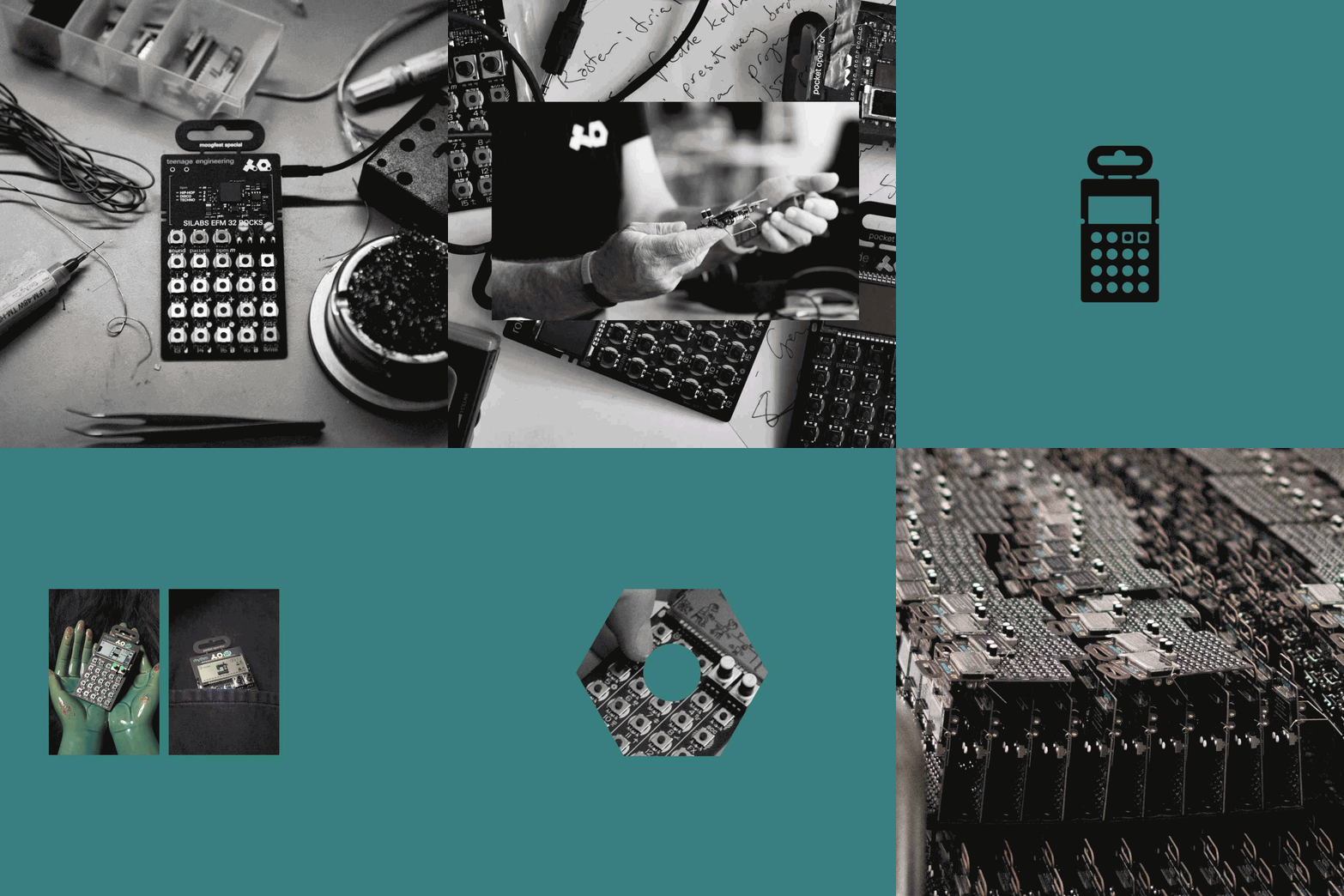
what started as an idea to grow the synth population has today earned its spot as the world’s most accessible music machine, making its way into hundreds of thousands of pockets—and counting.
the early days of the pocket operator go back to moogfest 2014, where we launched 200 screenless prototypes for betatesters and artists performing at the festival. 2015 was when things officially kicked off with a deal between us and ann-sofie back, then-designer at cheap monday. the trade? create the most affordable, pocket-sized synth in exchange for free lab clothes.
the early days of the pocket operator go back to moogfest 2014, where we launched 200 screenless prototypes for betatesters and artists performing at the festival. 2015 was when things officially kicked off with a deal between us and ann-sofie back, then-designer at cheap monday. the trade? create the most affordable, pocket-sized synth in exchange for free lab clothes.
PO-12 rhythm, one of the first pocket operators launched
with a tight budget and big ideas, we had to get creative with what we had. with a bare circuit board, an lcd screen and a few knobs, these tiny machines proved size is only half the story, becoming cult favorites for music lovers everywhere.
nine original models, three modular synths, two EP units, collaborations with gaming giants like capcom and just shy of a million units later, we’re looking back at the past ten years. to understand how it all came together, we sat down with a few of the people who helped bring the pocket operators to life.
nine original models, three modular synths, two EP units, collaborations with gaming giants like capcom and just shy of a million units later, we’re looking back at the past ten years. to understand how it all came together, we sat down with a few of the people who helped bring the pocket operators to life.
prototyping for new pocket operators
tell us about the initial idea behind the pocket operator. what were some of the inspirations?
oscar, head of development: we had been working on OD-11 for a long time and were honestly exhausted from such a tech-heavy project. there was an
itch to do something less demanding—something quick, iterative and fun. at the same time, we noticed the brand had a strong following, but both OP–1
and OD-11 were quite expensive and not everyone could afford them.
it was around this time that we started talking with ann-sofie back, then-designer at the swedish jeans brand cheap monday. we asked if she could design some free lab clothes in exchange for a cool, lo-fi gadget they could sell in their physical stores.
oscar, head of development: we had been working on OD-11 for a long time and were honestly exhausted from such a tech-heavy project. there was an
itch to do something less demanding—something quick, iterative and fun. at the same time, we noticed the brand had a strong following, but both OP–1
and OD-11 were quite expensive and not everyone could afford them.
it was around this time that we started talking with ann-sofie back, then-designer at the swedish jeans brand cheap monday. we asked if she could design some free lab clothes in exchange for a cool, lo-fi gadget they could sell in their physical stores.
po-24 office, one of three in the po-20 series,
launched in 2016
launched in 2016
all of that came together into the idea of the pocket operator: the most affordable synthesizer we could dream up. the ambition was to create something so accessible that even people who’d never touched an instrument could make music. there was also a bit of a pedagogical goal behind the first PO-10 series—they brought together three foundational elements of music: rhythm, bass, and melody—into a pocket-sized, low-cost form.
most of the design decisions were purely out of necessity. the look—bare circuit board, lcd screen, a few knobs—wasn’t about being clever. we just had to keep costs as low as possible.
most of the design decisions were purely out of necessity. the look—bare circuit board, lcd screen, a few knobs—wasn’t about being clever. we just had to keep costs as low as possible.
PO-32’s built-in mic use sound waves
to transfer and receive data
to transfer and receive data
magnus lidström is the head and heart behind sonic charge, a swedish software lab. in 2003, he launched microtonic: a drum machine in vst form that’s still a favorite today. later, we joined forces with magnus to help create the PO-32, PO-35 and the PO-137.
magnus lidström, coding for the po-32 tonic
to embed a microtonic vst plugin into a tiny hardware drum machine is not an easy task. that kind of deep integration hadn’t been done in that size or price before. how did this collaboration start?
magnus, founder of sonic charge: the original idea was to use the PO-12 code with samples made from microtonic. however, once i started experimenting with the hardware, i couldn’t resist the challenge of running the actual microtonic synth on it. it felt like black magic, getting sound transfer to work over audio, speaker to microphone. at the namm launch in 2017, people were blown away by that feature, especially those who grew up with home computers that loaded games from tape.
it helped move the needle from specifications and price to creativity and play, that it showed you actually didn’t need expensive or complex gear to make something original. it was fascinating how much personality we could get out of such a minimal interface and limited hardware. it’s design by constraint at its finest.
magnus, founder of sonic charge: the original idea was to use the PO-12 code with samples made from microtonic. however, once i started experimenting with the hardware, i couldn’t resist the challenge of running the actual microtonic synth on it. it felt like black magic, getting sound transfer to work over audio, speaker to microphone. at the namm launch in 2017, people were blown away by that feature, especially those who grew up with home computers that loaded games from tape.
it helped move the needle from specifications and price to creativity and play, that it showed you actually didn’t need expensive or complex gear to make something original. it was fascinating how much personality we could get out of such a minimal interface and limited hardware. it’s design by constraint at its finest.
magnus, demoing how to use PO-32 tonic with microtonic
what were some of its most memorable moments?
jonatan, senior engineer: releasing the first PO-10 series at namm in 2015 was a blast. we took preorders while still fixing bugs on the fly. after a full day at the trade fair, we tested the units back at the hotel, found new bugs, and i reflashed the demo units overnight so we could use them again the next day. but during the trip our homemade flash jig broke, so there was no real way to test the fixes. so, i had to solder it back together at the hotel using a footrest and a lighter.
the footrest is still a part of every pocket operator
till this day.
jens, co-founder and engineer: launch day at namm and the aftermath was intense. we had taken orders for 10,000 units on launch, which we shipped ourselves from the office. it’s hard to imagine the amount of work spent printing, packaging and shipping that many units, with just a few people.
jonatan, senior engineer: releasing the first PO-10 series at namm in 2015 was a blast. we took preorders while still fixing bugs on the fly. after a full day at the trade fair, we tested the units back at the hotel, found new bugs, and i reflashed the demo units overnight so we could use them again the next day. but during the trip our homemade flash jig broke, so there was no real way to test the fixes. so, i had to solder it back together at the hotel using a footrest and a lighter.
the footrest is still a part of every pocket operator
till this day.
jens, co-founder and engineer: launch day at namm and the aftermath was intense. we had taken orders for 10,000 units on launch, which we shipped ourselves from the office. it’s hard to imagine the amount of work spent printing, packaging and shipping that many units, with just a few people.
jens rudberg on the way to the namm show 2015
what change do you think the release of the
pocket operators brought about?
oscar: it’s a long list. most obviously pocket operators gave people an easy entry point into electronic music, even if they had zero experience. they also helped dispel the myth that you need big machines with loads of buttons to make something sound good.
pocket operators brought about?
oscar: it’s a long list. most obviously pocket operators gave people an easy entry point into electronic music, even if they had zero experience. they also helped dispel the myth that you need big machines with loads of buttons to make something sound good.
jonatan blomster, demoing the first
pocket operators at namm 2015
pocket operators at namm 2015
speaking from your own experience, what’s one thing you still find fascinating about the series?
jonatan: i thought we had squeezed out everything possible with the PO-10 series, so it was exciting to bring in new developers who really understood the concept and pushed it further. first it was linus with the PO-20 series, then magnus at sonic charge with PO-32, PO-35 and PO-137.
while working on PO-33, i was also making some ambient/drone music on the side and got frustrated that i couldn’t go slower than 60 bpm. so i snuck in an easter egg that most people probably don’t know about, until now; if you hold bpm, press a pad to set the volume five times, and then keep holding bpm, you can turn pot b to set bpm anywhere from 15 to 60. i don’t think anyone’s found it yet.
jonatan: i thought we had squeezed out everything possible with the PO-10 series, so it was exciting to bring in new developers who really understood the concept and pushed it further. first it was linus with the PO-20 series, then magnus at sonic charge with PO-32, PO-35 and PO-137.
while working on PO-33, i was also making some ambient/drone music on the side and got frustrated that i couldn’t go slower than 60 bpm. so i snuck in an easter egg that most people probably don’t know about, until now; if you hold bpm, press a pad to set the volume five times, and then keep holding bpm, you can turn pot b to set bpm anywhere from 15 to 60. i don’t think anyone’s found it yet.
po-133 streetfighter car at mantorp park race track, sweden
we would like to thank the community that has been with us for over ten years. you’ve joined two #PO10DIY challenges, built everything from synthitars, custom cases to receipt machines, made full albums with only pocket operators and made countless of amazing videos. here's to ten more years!
head over to our anniversary site and learn more about the history of pocket operators and explore some never released prototypes.
head over to our anniversary site and learn more about the history of pocket operators and explore some never released prototypes.
around the office:björn aspelin
february 13, 2025
if you’ve used our newer gear, chances are björn aspelin—our in-house cmf designer—had a hand in bringing it to life. ‘cmf,’ an abbreviation for color, material, and finish, is a part of his world; björn makes sure every product looks and feels better with each iteration. the bulk of his work involves aligning colors with the original vision, researching materials, and perfecting finishes. in other words, björn ensures our products look and feel as purposeful as they’re engineered to be.
“my focus is to bring an idea to life through colors, materials, and the treatments and finishes of our products,” björn explains. “someone might come to me with just a sketch, a mood board, a single word, or even an early prototype. my job then becomes to substantiate it through visual appearance and behavior.”
“my focus is to bring an idea to life through colors, materials, and the treatments and finishes of our products,” björn explains. “someone might come to me with just a sketch, a mood board, a single word, or even an early prototype. my job then becomes to substantiate it through visual appearance and behavior.”
björn’s latest work can be seen in his involvement with OP–XY, a project as challenging as it was rewarding. “the first major hurdle was scale,” he reflects. “the form factor and overall design properties of the field system became the cornerstone for what the OP–XY would become.
as it is technically a part of the series, we had to stay true to the established aesthetic while still having it stand on its own.”
as it is technically a part of the series, we had to stay true to the established aesthetic while still having it stand on its own.”
another major challenge was color. given the limited variations in the existing color systems, björn developed a signature teenage engineering grayscale gradient in a city further south of sweden. “the grayscale gradient running across the length of the device became the centerpiece, reflecting music scales and the 16 programmable tracks. it took countless revisions to get it right. existing systems didn’t work for what we needed, so we created our own: the teenage engineering scale. it’s subtle, but a lot of thought went into it.”
it is this kind of problem-solving that shapes björn’s day-to-day work. questions like: how do we visually express a product’s durability? should the expression be playful or luxurious? but it is not just about how things look—other considerations that need to be kept in mind are ergonomics, ease of cleaning, and functionality. to him, the technology of each device needs to be reflected through its exterior in a way that makes sense. he traces the technical aspects of a product down to what, to him, could be felt and touched, then creates an appendage between software and visual appearance.
“cmf design demands precision and care,” he says. “it’s a time-intensive process, revisiting sample after sample, translating concepts into materials, ensuring consistency, and perfecting the final look. but it’s deeply rewarding. think of it as composing a film score—bringing together color, material, and finish to create a harmony that brings the whole story together.”
“cmf design demands precision and care,” he says. “it’s a time-intensive process, revisiting sample after sample, translating concepts into materials, ensuring consistency, and perfecting the final look. but it’s deeply rewarding. think of it as composing a film score—bringing together color, material, and finish to create a harmony that brings the whole story together.”