september 19, 2024
we've added an impressive set of new features for the TP–7, making it more than just a tape recorder. inside, lies an advanced recording and editing system for all audio purposes, packed with new features. the workflow has been carefully optimized, whether working with multi-track recordings or just aquick memo.
turn on metronome and count-in, set cue points for your arrangements andre-do takes, loop and scratch, bounce, or just play back your favorite high-res record collection. plus we have a new model with multi language support in the TP–7 app that makes transcription in most languages a breeze.
let's take you through some of its new features.

right on cue.with the new software update, recording and editing on the TP–7 has gotten a huge expansion in features. the new cue and loop utilities in TP–7 adds the ability to define cue points for instant recall, takes, and flexible, creative looping.

full midi control.the TP–7 software update adds expanded midi modes for clock sync, control surface, and cue control, enabling tighter timing with other gear and hands-on control over any digital audio file.

bounce the track.another added feature of the TP–7 is its capacity to bounce your stems down to a single stereo file. as well as adding additional tracks to an existing file.


multi-language.whether you're a dentist capturing patient notes, a podcaster recording interviews, or an artist documenting your creative process, the TP–7 makes transcription in most languages effortless. just connect to the TP–7 app,choose your preferred language, and hit transcribe.


how to update:use our update utility or visit the downloads page and follow the steps to update your TP–7. 
click here for a complete list of changes.click here for the updated user guide.
TP–7


september 6, 2024
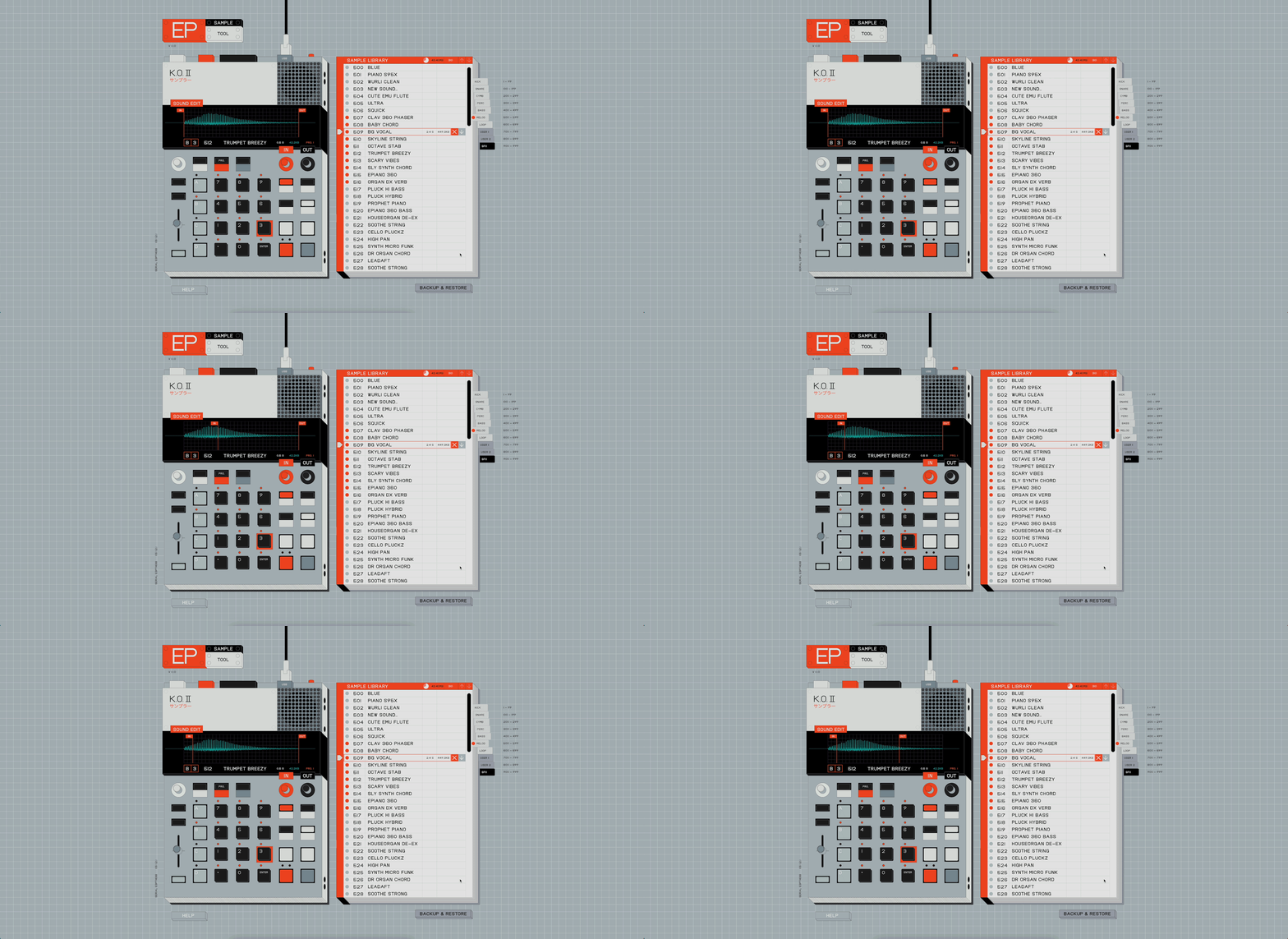
our EP sample tool is your go-to for managing samples on both EP–133 K.O. II and EP–1320 medieval. it lets you freely move your samples and jump them to your mac or pc.
upload, download, delete, edit, and assign samples to pads in a snap. use your web browser and connect to your EP over usb, so you can take full control of your samples. 
let's rehash the steps for you, shall we?
step 1go to teenage.engineering/apps/ep-sample-tool and connect EP to your computer using usb-c, turn it on, and turn the volume up.
step 2once connected, the sample tool will show your sample library and be ready for use.
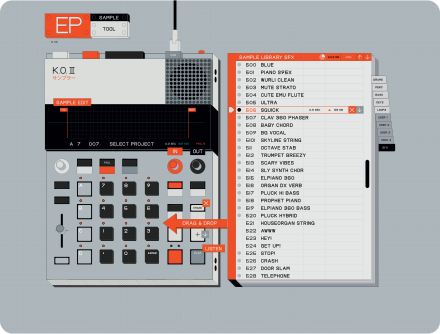
interface overviewwe'll be using the EP–133 K.O. II as an example, but please note that the functions of the buttons follows the exact same for EP medieval, too.
edit sound on the left main interface using 'in' and 'out' positions, access groups A-D, and use the 12 pads. the 'main' button lets you select a project.
use your cursor to click and drag. the lower section shows group and pad allocation, sample slot number, name, length, and the current loaded project.

 main interface, sample library 
main interface
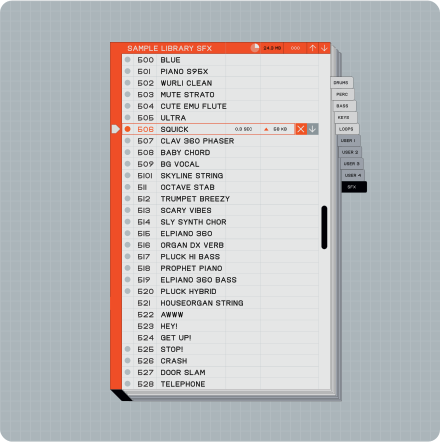
this is the sample library with all the samples currently stored on your unit.the library hosts 999 sample slots, divided across ten tabs. feel free to move things around!

orange dot
the orange dot tells you that the corresponding sample is assigned to a pad within the active project or and group. clicking it will activate the pad, double-clicking will highlight the sample
the top bar of the sample sees a pie chart and number, indicating the amount of space used, and specific mb.
use your cursor to interact with the sample list—click on the samples and tabs, or drag and drop. double-click a sample to quickly rename it.

step 4
assign samples to pads
drag and drop your samples from the library list onto a pad in orderto assign it.

DROP YOUR SAMPLES ACROSS ANY OF THE 12 PADS
step 5
edit samples
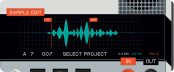
press (shift) and (sound) on your unit to enter sound edit mode. now press (minus)/(plus) until the display says 'tri' (trim). you can now use the (x) and (y) knobs on your unit to adjust the on screen ‘in’ and ‘out’ positions of your current sample.

USE ‘IN’ AND ‘OUT’ TO CUSTOMIZE YOUR SAMPLE AND ADJUST IT AS YOU WISH
step 6
upload samples
upload your own samples to your unit by dragging and dropping your files from your computer to the sound library in your browser.
  • dropping multiple samples in the library will assign them to the first free library slots in the row they were dropped on. dropping more during an active upload will store them to the upload queue.


  • drop samples on an active group will upload all sounds to the library, and up to 12 samples will be assigned to pads in that group. dotted red border indicates which pads will be assigned.

spotted a green dot ? that means the sample successfully uploaded from the upload queue.

upload an import your own samples by drag & drop
step 7
download sample

download one or multiple samples to your computer by clicking the 'arrow down' icon on the sample row.

download one or mutiple samples to your computer
step 8
delete samples
delete one or multiple samples by clicking the 'X' icon on the sample row.
note: deleting will permanently remove samples from your unit, so make sure you have them backed up on your computer if you need them!

delete one or multiple samples by clicking the 'X' icon on the sample row
watch the full 'how to use' video below.
last week, we traveled off to the remote swedish island of gotland to unveil the EP–1320; our new pint-sized and portable medieval beat machine.

ep–1320, the world’s first medieval electronic instrument
we coincided the launch of the EP–1320 with the famed medieval week in gotland; an eight-day pageantry and celebration of the island's medieval history. historically accurate and imaginative in equal measure, visitors are invited to marvel at the well-preserved medieval architecture, chug down some locally brewed mead and watch the tower games – all decked out in their finest medieval garb.

the official teenage engineering launch pad at the medieval fair
the festival also celebrated its 40th anniversary this year, marking it as the largest historical festival in swedish history. more than just a festival, medieval week is a study of history, a retrospective where people can revisit the relics of the past that are found everywhere.
initially founded as a research foundation focused on public education; medieval week is today a place people travel in their tens of thousands to visit the island, and learn about the magic that meanders every crack, and crevice of the city.


on the last day, the teenage engineering team took to the streets, parading the island in a synchronized performance. some, carried via horse and carriage, spent their time improvising a 45-minute track with the EP–1320. it’s safe to say that we caught a resident’s eye, or two.

the team, criss-crossing off the beaten paths of visby, gotland

EP–1320 MID-ACTION, CARRIED via HORSE AND CARRIAGE

press play and follow the behind the scenes of our visit.
EP–1320 medieval


june 5, 2024
we released TP–7 in may 2023, but the seed for the project actually started all the way back in 2018. in fact, TP–7 decided the physical form that the rest of the field series would take, even influencing the features on OB–4. to understand how it all came together, we spoke to some of the people who helped bring the TP–7 field recorder to life during various stages of its development.
guffe is head of mechanical engineering, involved in almost anything to do with mechanics here, tomas is the electrical engineer who has been responsible for the electronics and software on TP–7 from the very beginning, and marcus is the product owner overseeing the final stages of product development.


what was the original idea behind TP–7?
guffe: jesper had sketched a modular audio/studio system with numerous fantastic designs, which were quite different in style from what eventually became the final product, but definitely laid the foundation for what the field system would become. at some point, jesper and i, along with others at teenage engineering, discussed the idea of creating a new/modern nagra – a world-class portable audio recorder in terms of both sound quality and design.we began evaluating various form factors that felt magical, like a snus box, cigarette pack, soda can, etc. i built an mdf model based on one of jesper's sketches, and it is almost identical to the final design. over the years, the project went through many iterations internally, although the external design remained consistent throughout.
tomas: i started working on the first revision of the electronics for TP–7 back in april 2018. having recently worked on the raven r for baidu, we wanted to take the things we learned about motor control and bring it to a recording device. a lot of effort went into getting a responsive and intuitive feel using the reel. 
one of the intentions going in was that you had to be able to scratch on it. we started on TP–7 before deciding to motorize OB–4, so the only reason we could [make the OB–4 motorized wheel function] was due to the work we did on the TP–7 motor.


what were some of the hurdles you had to overcome when bridging the design with functionality?
guffe: creating a small premium product packed with mechanics, electronics, antennas, and more is always a demanding and time-consuming task. we have also worked hard to ensure repairability and ease of assembly, which significantly increases the complexity during the development stage.
it is important to note that this is not a high-volume product, so we have constantly had to invent new ways to solve problems. in contrast to a product sold in millions, where new manufacturing methods and machines can be developed to address issues, our approach had to be more innovative and resourceful.
for this particular product, i would say the biggest challenges have been the antenna (in-molded) and the three different plastics that are molded into the metal before it is cnc milled and surface treated. 


tomas: initially the idea was to use the same battery as OP–Z and an sd-card for storage, which required a stack of 7(!) different pcbs to fit everything in the correct position. but the battery life would have been too short, sd card performance too unpredictable and the antenna wasn't working well enough. so we eventually redesigned the electronics to what it looks like today, which also made it much easier to fit everything we wanted.
marcus: it’s also a challenge to make an intuitive user interface based on the tiny display and limited amount of buttons. with this product, we also tried to reach a broader crowd than usual which was its own challenge.
being a multi-track high resolution audio device, there were some tough demands on the system to handle a lot of data in realtime. then of course the spinning wheel with its motor and sensors adds a huge amount of complexity for all teams, requiring many hours of work to get the desired function.
guffe: to my knowledge, no one else has done what we have achieved!
TP–7


how do you make a documentary about a prolific artist who has been working for over five decades, across multiple mediums, and holds an archive of over 500 hours of footage? director gary hustwit may have the answer.

gary hustwit at a live screening of ‘eno’.
'eno' is the first documentary about the pioneering artist brian eno, and the first generative feature film. the narrative is structured at the whim of 'brain one', the proprietary generative software created by hustwit and digital artist, brendan dawes. using an algorithm trained on footage from eno's extensive archive and hustwit's interviews with eno, it pieces together a film that is unique at each viewing. as the order of scenes perpetually changes and what’s included is never certain, the version you see is the only time that iteration will exist."in some ways, the film is kind of like exploring the insides of his brain… it's different memories and ideas and experiences over the 50-yearplus time frame."

digital artist brendan dawes and hustwit generating the film live.
according to hustwit, brian eno had no interest in making a biographical documentary "because they were always one person's version of another person's story. and he didn't wanna be anyone else's story."
"i started working with brendan dawes, the programmer and digital artist, and we built a demo version of the initial software using a lot of the footage, music and material from ‘rams’ (hustwit's previous film, scored by eno). 
i went back and i showed it to brian, maybe six months later, and he was just blown away by it. he just said, 'this is something that i've wanted to do for so long.' he obviously uses generative technology in his music and in his visual art, but he hadn't done anything with video, and this is sort of a combination of a generative art project and a traditional documentary."
how the software works is a combination of mapping the footage and coding a sense of narrative structure, "looking at scenes and different types of footage and using a taxonomy of what it's doing or representing. it's not just metadata, it's emotional data. and then you have to look at what makes an engaging film: there's a rhythm in the types of scenes and the connections between them, and there's a feeling of progression as you're watching the film."

'ENO' AND B–1 HAVING ITS LONDON PREMIERE AT THE BARBICAN.
given the current discussions around ai and its impact on artistry and authorship, creating a film reliant on the technology is a controversial but inevitable move. however, the software that hustwit and dawes have built may just hit the sweet spot where human meets machine; where the algorithm works to respect the material and facilitate an artistic vision.
"i always say it's artist's intelligence, it's not artificial intelligence. because we've programmed the system, it's not like we trained it on other people's films or something. we programmed it with our intelligence to do a very specific thing, which is to make this film but make it different, make it work from an editorial standpoint regardless of what individual footage and scenes get put in.
"he had 500 hours of footage in his archive that we got access to. you can't even get 1% of that into a normal film. so this approach was a way that we could dip into a lot of that material, or at least have it be in the mix somewhere… it's very good for dealing with huge amounts of information."

B–1 tape reels and controls generating the film for a live screening.
to accompany this one-of-a-kind viewing experience, we designed a hardware version of 'brain one'. B–1 is a deck with two spinning reels and controls: play, rewind, rec and generate; the latter being used to generate the sequences of the film, which can be seen on the screen in real time.
"people just freak out when they see it, everyone wants to know what it's doing, everyone wants to press the buttons, everybody wants to rock the reels."[B–1] is now this embodiment of the idea of a generative film. because there's never been a generative feature film before. there's never been a generative feature filmmaking machine before. so i think that both i and brendan, and everybody that we worked with at teenage engineering, just like those kinds of challenges."
you can see B–1 in action at a selection of the 'eno' live screening events this year, each audience viewing a one-off version of the film. "there's something kind of special about that. and i also think it's really important to get people back into theaters. this is a way to help that happen, to create a unique communal experience."
modern biology, aka tarun nayar, plugs into mushrooms and he wants us to listen. by sending a small electric current through mushrooms and plants (anything with a bioelectric pulse) he creates ambient soundscapes conducted by nature, inviting us to join him in paying attention to the life that is pulsing all around us.

tarun nayar, aka modern biology (photo by Johanna Robertson)
"this approach grew out of 'the secret life of plants', a seminal book from 1973. the first chapter focused on this guy called cleve backster, who was at the time the cia's top lie detector expert. he got to doing these crazy experiments with plants, where he basically was using lie detectors on plants to see if they could tell whether he was telling the truth or not. in a lie detector, you have this little sensor which basically allows your thumb to connect a circuit, and as you get nervous, as you lie, you get sweaty and the connectivity increases. so with the plants, all you're doing is placing the electrodes, with a tiny current running between them, and as that current jumps up and down due to natural bioelectric processes in the plant or the mushroom, that's when the notes go up and down."
nayar uses a device which converts these impedance changes into control voltage and gate signals that can be used as a generative source on a modular synthesizer. he then riffs off this randomized composition, running the notes through his synthesizers of choice, often an OP–1, adding effects to create ambient soundscapes.

WATCH AND LISTEN TO MODERN BIOLOGY CREATE MUSHROOM MUSIC WITH OP–1.
"[the sensor device] is something that you can build for 25 bucks. i'm using a 'scíon' at the moment, from a scottish synth company. i've been drawn to the way that these scottish guys have done it, i think it's the most elegant and musical interpretation, but you can build your own [sensor] with an arduino or a raspberry pi."
nayar is just one in a field of like minded artists who have turned their attention to the natural world as a source of direct inspiration – the seed of which is often attributed to the demanhur foundation with the release of the record "music of the plants" in the 1970s. 

A MODERN BIOLOGY FIELD TRIP FEATURING OP–1 FIELD 
growing up playing indian classical music, nayar focussed on the tabla (wooden hand drums), which he played in the band 'delhi 2 dublin', before adding synths to the lineup. "i'd always been fascinated with synthesizers because they were like the easiest way to create harmony and melody for somebody who didn't play a melodic instrument."
"i was up on this little island north of [my home in] vancouver for most of the pandemic, surrounded by nature with all of my synths. one of my friends brought over… a plant bioelectricity converter, and we plugged it into the modular synthesizer."
already far down the road of generative synthesis, nayar connected his first plant, a salmonberry bush, and understood that he "could use the natural world as the source for generative information"

MODERN BIOLOGY IN STOCKHOLM (PHOTO BY BETSEY GUSMAN @BETSEYPH) 
since then, nayar has performed around the world in forests (what he calls "field trips"), and more conventional venues. he often begins by asking his audience to take in their surroundings and forage for a sound source.
when we join nayar on his field trip in stockholm, it's early spring so we are low on mushrooms, but flush with fresh foliage. he plugs into a cherry blossom, which he picked up in town earlier in the day, and it begins to pulse. what follows is a meditative experience that draws our attention to our bodies and the environment.
"i've chosen to do these events outside with silent disco style headphones,...there's something about the field trips itself with headphones, where you're outside in community, but you're sort of in your own zone, and it's really a prompt to connect with nature in a way that feels good for you."
"i think that there is this kind of ineffable magic that happens, and i think everyone's experience is quite personal."

MODERN BIOLOGY IN STOCKHOLM (PHOTO BY BETSEY GUSMAN @BETSEYPH) 
"i do appreciate the movement that i've seen at the moment amongst synth makers and designers, making stuff more portable, because i think that really opens [things] up… just being out in nature gives rise to a whole other set of creative possibilities, and having people thinking about that when they're designing instruments is very helpful."
out on our field trip, a few kids get up to facilitate the electrical circuit by holding hands, before a "mushroom tickler" is called upon to activate some energy in a stone morel mushroom (poisonous but they eat them in finland). nearby, a man stands in the middle of a clearing and faces the sun, catching the day's last light.
explore OP–1 field
pocket operator modular 400
MAy 16, 2024
one year ago we released CM–15 into the world; our tiny, portable, studio microphone with a large-diaphragm capsule, integrated audio converter, built-in preamp, 3.5 mm jack and a 48v phantom powered mini xlr. it was a lot to fit into a small frame – but we did it. all thanks to a dedicated team, including engineers alberto and marcus.

Alberto 
alberto: i'm a senior electronic engineer and i design and develop electronic systems for our products. my responsibility is often across the whole lifecycle from block schematics sketched to mass production. in the case of CM–15, since the r&d phase was so challenging and extended, i grew into being responsible for the whole product over time, together with marcus.
marcus: i'm a mechanical engineer and i’ve been involved with all the field products, including CM–15. the mechanical engineering process at teenage engineering is very experimental and iterative and often requires unusual solutions or customized parts in order to meet the design requirements. i have been involved in most of these projects from the early design to finally putting the parts on the factory floor and starting production.

Marcus
can you tell us what the original idea for CM–15 was, and some of the inspirations?
alberto: the original idea was to create a portable microphone without compromising the quality you would normally get in studio settings, and one that completed the field mini series.
marcus: The CM–15 project was initiated as a crazy idea to make a microphone in the same size as the TP–7, which was the original product developed in the field series. the size and thickness was designed many years before, but the final form was heavily influenced by the field desk clamp system and many of our other internal designs. it was actually frankenstein-ed together from an early prototype of a speaker grille inspired by the OD-11 and a napkin sketch of a microphone.


what were some of the biggest challenges you had to overcome when bridging the design with functionality?
alberto: it's a long list! but first of all, power and power consumption. we had to deal with an externally provided 48V input that is considered "high" in consumer electronics, which has a limited current available. implementing the automatic power switching between this voltage and much smaller voltages like 5V from usb and 3.7V from the battery, and doing it efficiently enough, was the first challenge. 
the second challenge was size: we had to deal with huge resistances up to 500MOhm to provide a stable polarization voltage of 80V to the capsule, on a very dense pcb and with the aluminum enclosure in proximity. when your circuit functionality depends on such a big resistance, you have to consider elements like moisture, dust and residue. proximity can totally disrupt the system. another size-related issue was the limited space on the pcb that required a sophisticated high-density design with digital and analog sections separated from each other on a 55x20mm pcb, while keeping the noise level at 11dbA.
last but not least, acoustics: the sides of the CM–15 are quite thick, and that created some acoustic imperfections that we had to compensate for both with electronics equalization at the preamp stage, and at a mechanical level. the parallel sides of the case created a standing wave at around 7 kHz that we reduced by introducing a custom foam. this is part of how the sound of CM–15 came to be, from design limitations.
marcus: typically, microphones don't have any nearby walls to reflect incoming audio near the capsule as it can cause cancellation or amplification at certain frequencies. however, with some iteration and creative work, we were able to tame the effect to a more respectable level. as a plus, the resulting frequency response of the microphone works as a natural passive de-esser on vocals which gives our microphone a unique character that can be hard to obtain with other designs. 


with all that said, what were some of your favorite things about the project?
alberto: the friendship with marcus that grew from navigating international manufacturing challenges is for sure number one. then the satisfaction of bringing a product to life that we thought was impossible. and then there's everything i have learned about audio and the consumer electronics industry in general! i'm proud of the final product. it's a superior-sounding microphone, versatile as the whole field mini-series – it's timeless. i see it as a product with longevity, which is very important for me. 
marcus: i agree with alberto, i'm very glad that the final result is a timeless device that will work as a versatile companion for music creation for many years in the future. it's been great to work with alberto, he's become a close friend, and it’s clear to me now that you can do so much with a small team and a large dose of willpower! 
explore CM–15
explore tripod mini
last year our friends at modem, a design and innovation studio, conducted an audiovisual experiment with the OP–Z. now they're back with a new project for EP–133 K.O II.
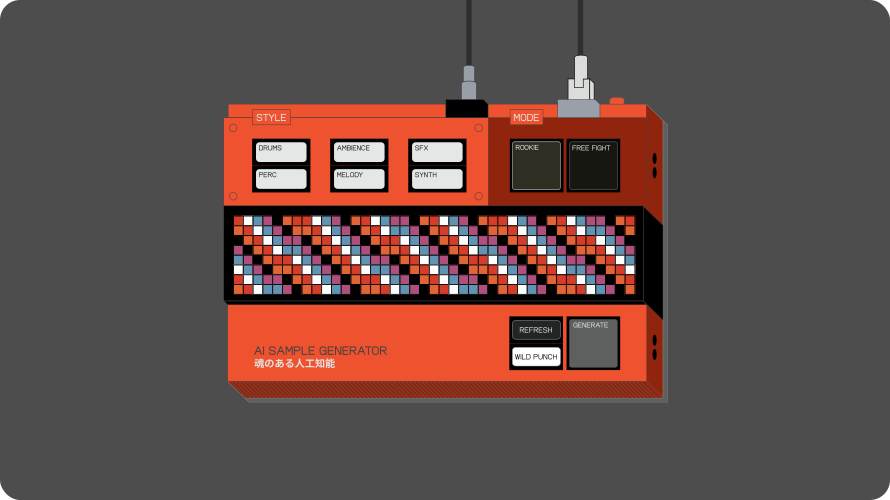
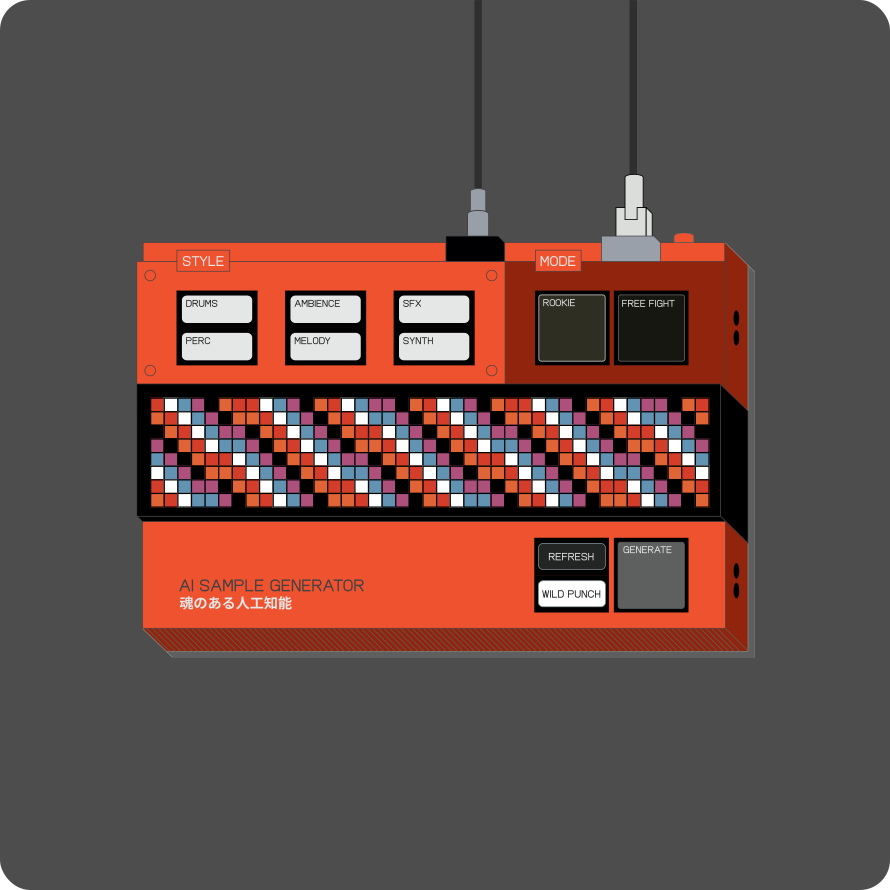
inspired by our EP sample tool, they created a sample generator that turns text prompts into unique samples. feed a description of a feeling or sound to the sample generator and let the tool generate a unique sound. 
modem, together with bureau cool, have designed and engineered the sample generator using meta audiocraft's open-source audio model. an experiment aimed to merge traditional sampling techniques with technology.


the sample generator is available to use for a limited time. to give it a spin, this is how you do it:
step 1: generate samplessimply describe the sound you want to hear in text, from a "shredding guitar riff" to a "jazz flute solo" and let the sample generator transform your vision into audio.
step 2: transfer samplesdownload the auto generated samples as a .wav file and transfer them to the EP–133 K.O. II using the teenage engineering EP sample tool. 
step 3: make beatssequence your generated samples on the EP–133 K.O. II, tweak them to your liking, and start making beats.

explore the sample generator
learn more about EP–133 K.O. II here

OP–1  louder, thinnerand 100 times better
april 5, 2024
OP–1  is the evolution of the OP-1, injected with more than a decade of ideas, refinements and improvements. let's dive into just some of the 100 new features:

dimension synth
dimension synththe new subtractive synth engine creates the most lush, analog sounds you can get on this powerful little machine. get experimental and combine it with the lfo, it's a versatile synth for all kinds of sound design.


mother reverb effect
all new effectswith the new reverb effect, mother, you can create nostalgic pads and textures. terminal is a bit crusher effect with an anti-aliasing feature that gives you just the right amount of lo-fi goodness.


stereo functionality
stereo functionalitywhile the original OP-1 was known for easy and fast sampling, OP–1  turns it up a notch with stereo sampling. stereo functionality brings more life and depth to your music. two channels = double the fun!


velocity sensitive keys
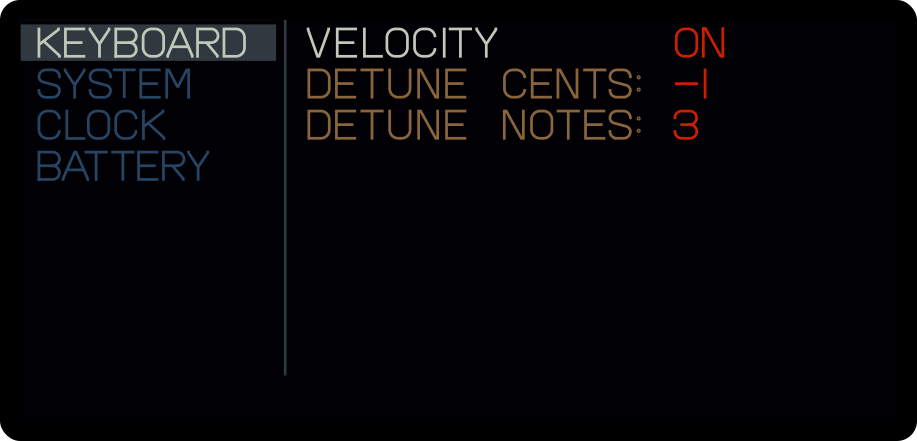
velocity sensitive keysvelocity sensitive keys turned OP–1  into an expressive instrument with dynamic playing power, especially drums. you can also use it with internal sequencers, and over external midi, when using OP–1  as the main controller for other devices.


vocoder
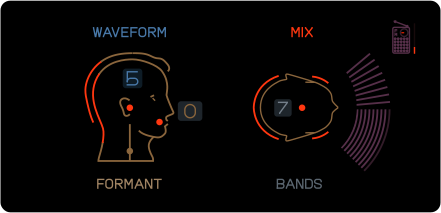
vocoderno more pedals. the vocoder update allows OP–1  to use any input source as a modulator. the audio input is passed through 20 filters with controllable bandwidth and formant shift. the carrier signal is a custom 7-oscillator polyphonic synth that goes from a single sawtooth to pure white noise.


four tape styles
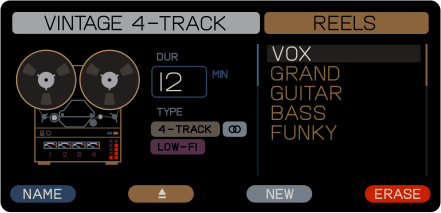
four tape stylesOP–1  has four tape styles to choose from, each adding their own unique texture to your tracks: studio 4-track for clean studio recording, vintage 4-track for that warm, saturated 70s feel, porta 4-track gives a lo-fi, noisy sound, and disc mini is a purely digital compressed 90s sound.


fm transmission
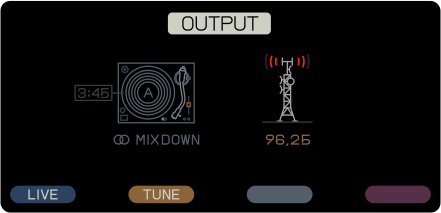
fm transmissiontune into the radio, or send out to one. OP–1  has a built-in fm transmitter and receiver to sample from the radio directly through your OP–1 , or transmit audio to your OB–4 to use it as a studio monitor, or from the backseat to your car stereo.

explore all the 100 new features
OP–1 
MARCH 14, 2024
OP–1 club is a collective of musicians and producers based in mexico city who perform together with a bunch of OP–1s, and other teenage engineering gear, at events around the city and beyond. we caught up with orestes, bernardo, ferdi and sami to find out what OP–1 club is all about.


who are you and what do you do?
orestes: i am a musician from venezuela living in mexico, mixing jazz, hiphop and traditional music from my country. i also work with many latin american artists and most of the time i'm on tour with many friends. i've made music for tv series like ''godfather of harlem'' and also for video games like ''ufc 5''. i've also collaborated with run the jewels, nick hook, danny ocean, akapellah, apache, micro tdh and neutro shorty. 
bernardo: i'm bernardo pérez, mexican musician, composer and producer. i have a solo project called 'real suabidad' and a two man band called 'bicho blanco'. i produce other people's music, i score short films, dance films and commercials. i also host a weekly radio show.
ferdi: i'm fer gonzález a.k.a mezcalibur, musician and producer from cdmx. i've been producing music for a while, currently finishing some tracks of my own. i've always been influenced by (mostly) heavy electronic music like breakcore, dubstep, jungle, uk garage, idm and obviously all the latin music subgenres that have been emerging these last few years, like moombathon, neoperreo, guaracha and reggaeton, to name a few.
sami: i'm sami mendoza, musician and producer from mexico. i play with different artists mostly hip hop, rnb and jazz music. 

OP–1 Club "Agua Verde" 
tell us about OP–1 club, when and why did you start it?bernardo: it started formally some time during 2021. some of us had been getting together to jam only with teenage engineering gear. after a couple of times doing this it was clear there was great chemistry between us and a fascination with the possibilities these devices would allow. 
orestes: after several videos, there was one that went viral. i remember that many important musicians shared it, including timbaland, and that's when we decided to create the band. OP–1 club began as a project of ours but it really has a collective vision that over time will Include several visual artists, producers, creatives, and all lovers of teenage engineering, like us. i am very lucky to have a band with my favorite latin americans.


run us through what someone can expect from an OP–1 club event?orestes: the OP–1 club shows are incredible! the audience will listen to music created in the moment, which won't be repeated again. we all come to the shows with different sounds in our OP–1's and then during the show we decide by ''song'' or moment which instrument each one will play. for example, in the first song i play the drums, sami plays the keyboards, berni plays the melody, and ferdi plays the bass, somewhere along the way we pick a bpm and a key. for the second song we repeat the process, but we alternate instruments. 
during the shows we try to set it up so that the audience stand around us, so they can see everything up close. on the table we only have teenageengineering gear. we mainly use the OP–1 field but we also bring OP–Z's, the POM-400, various pocket operators, OB–4 for monitoring, and two TX–6 mixers. we also have guest rappers, singers and musicians for part of the performance. a common guest of ours for the shows is tino el pingüino, an incredible mexican rapper who has been close to the project since day one. 
what has happened in the time between starting it and where it is today?orestes: since we created the band, we have had several incredible concerts, and recorded many short videos, and just last year we got together for a couple of days to hang out and record our first studio album, which will be out around may. this year we hope to start a tour here in latin america and to be able to show our art to the whole world.


what are some of your favorite stories from your events?orestes: our first show we were expecting 50 people and about 400 showed up. we had a full house and many people didn’t make it in. it was wild.
bernardo: i can't remember one specifically, but i've loved the times when, unexpectedly, rappers or singers or other musicians in the crowd have joined the jam and all of us together created something incredible in the moment that captivated us and the audience.
ferdi: every time we get together to play is different so it's kind of a mystery to know what is gonna come out of the set even if we have already pre-selected sounds or samples... i like to see the surprised faces in the audience when some strange or unexpected sound happens during the set. 
sami: for me, one of the things i like the most is the energy of the people and their reactions. since everything is happening in the moment, it becomes something spontaneous and full of surprises - you never know what is going to happen. that connects a lot with the audience because in the end they become part of the unexpected.

OP–1 Club LIVE @ House Of Vans, CDMX
"back in the autumn of 2007, four friends sharing a garage workshop, were unexpectedly approached by absolut vodka to create an art installation. a year later, after long nights of building and coding, it was ready – the absolut choir – a machine made out of 22 wooden dolls that sang in harmony."
- jesper kouthoofd

the original choir
11 years later we made them smaller and invited them into your homes,but getting there required a redesign and technical modifications, both in software and hardware. adapting the original code was our software engineer, linus åkesson.

sketches of the original choir
linus: "the songs in the dolls are public domain works, but they had to be transcribed to a machine-readable format, in this case a list of notes, syllables and timing information. for instance, if the printed score showed an eighth-note c followed by a sixteenth-note d-sharp, i would type in 'c8 d#16' and the lyrics had to be transcribed to a phonetic representation, where e.g. 'my tears' would be typed in as 'mai ti@rs'.

LINUS AND THE CHOIR
"whenever the dolls are singing, they also scan for nearby singers using bluetooth. they connect, synchronize their clocks, and collectively decide what song to sing. the songs are stored in a database inside each doll, and the lyrics are expressed phonetically. these phonemes are then converted to numbers representing muscle movements in a simulation of the vocal tract of ahuman being."

GISELA BEING FORMED
production manager, evelina lindström, led the production of choir, taking the new design through the manufacturing process, using some creative problem solving along the way.
evelina: "one of the biggest challenges was to make a user-friendly interface that is easy to understand, one that works with each different doll, and at the same time has that teenage engineering feeling. to get the correct feedback and response when using the dolls is key, so we worked really hard on finding the correct balance between functionality and technicality, doing a lot of testing and creating updates to the user interface during the entire developmentof choir."

PRODUCTION MANAGER, EVELINA LINDSTRÖM
linus: "we wanted to use as much of the original code as possible, to maintain the spirit of the "big" choir from the early days of the company. but this code was written for desktop computers, not small portable devices, so i had to jump through hoops and find creative ways to make the code run faster and use less memory. at an early stage of adaptation, we hadn't implemented the function to turn the dolls off, so when one of our electrical engineers brought some dolls to a test facility an hour away, the dolls were hollering for the entire trip."


getting the hand polished treatment
evelina: "working with wood, especially a product combining wood and electronics, is a bit special since both materials behave in different ways. luckily we have really skilled craftspeople working in our wood factory and they are always aiming to get details, like pairing the color and texture of the wood with the fitting of parts, as optimal as possible.

PRODUCTION MANAGER, EVELINA LINDSTRÖM
"one of the things i'm really happy about is that we managed to give each doll their own personality. they all differ in how, what and when they sing. like a real choir, they can also sometimes mess up and even misbehave at times, they’re fun features that make the product feel more alive and hopefully, keep the audience entertained. 
i'm also really happy that choir can be connected with OP–1 field and OP–Z, giving room for a lot of creative choir arrangements. i'm really looking forward to seeing and hearing what innovative arrangements people are goingto create!"

watch choir being crafted in the factory.
teenage engineering choir

we've added an impressive set of new features for the TP–7, making it more than just a tape recorder. inside, lies an advanced recording and editing system for all audio purposes, packed with new features.the workflow has been carefully optimized, whether working with multi-track recordings or just aquick memo.
turn on metronome and count-in, set cue points for your arrangements and re-do takes, loop and scratch, bounce, or just play back your favorite high-res record collection. plus we have a new model with multi language support in the TP–7 app that makes transcription in most languages a breeze.
let's take you through some of its new features.

right on cue.with the new software update, recording and editing on the TP–7 has gotten a huge expansion in features. the new cue and loop utilities in TP–7 adds the ability to define cue points for instant recall, takes, and flexible, creative looping.
full midi control.the TP–7 software update adds expanded midi modes for clock sync, control surface, and cue control, enabling tighter timing with other gear and hands-on control over any digital audio file.
bounce the track. another added feature of the TP–7 is its capacity to bounce your stems down to a single stereo file. as well as adding additional tracks to an existing file.


multi-language.whether you're a dentist capturing patient notes, a podcaster recording interviews, or an artist documenting your creative process, the TP–7 makes transcription in most languages effortless. just connect to the TP–7 app, choose your preferred language, and hit transcribe.
how to update:use our update utility or visit the downloads page and follow the steps to update your TP–7.

click here for a complete list of changes.click here for the updated user guide. 


TP–7
EP sample tool
SEPTEMBER 6, 2024
our EP sample tool is your go-to for managing samples on both EP–133 K.O. II and EP–1320 medieval. it lets you freely move your samples and jump them to your mac or pc.
upload, download, delete, edit, and assign samples to pads in a snap. use your web browser and connect to your EP over usb, so you can take full control of your samples. 
let's rehash the steps for you, shall we?
step 1go to teenage.engineering/apps/ep-sample-tool and connect EP to your computer using usb-c, turn it on, and turn the volume up.
step 2once connected, the sample tool will show your sample library and be ready for use.
interface overviewwe'll be using the EP–133 K.O. II as an example, but please note that the functions of the buttons follows the exact same for EP medieval, too.
edit sound on the left main interface using 'in' and 'out' positions, access groups A-D, and use the 12 pads. the 'main' button lets you select a project.
use your cursor to click and drag. the lower section shows group and pad allocation, sample slot number, name, length, and the current loaded project.
 main interface, sample library 
this is the sample library with all the samples currently stored on your unit. the library hosts 999 sample slots, divided across ten tabs. feel free to move things around!

the orange dot tells you that the corresponding sample is assigned to a pad within the active project or and group. clicking it will activate the pad, double-clicking will highlight the sample
the top bar of the sample sees a pie chart and number, indicating the amount of space used, and specific mb.
use your cursor to interact with the sample list—click on the samples and tabs, or drag and drop. double-click a sample to quickly rename it.

step 4
assign samples to pads
drag and drop your samples from the library list onto a pad in orderto assign it.
DROP YOUR SAMPLES ACROSS ANY OF THE 12 PADS
step 5
edit samples
press (shift) and (sound) on your unit to enter sound edit mode. now press (minus)/(plus) until the display says 'tri' (trim). you can now use the (x) and (y) knobs on your unit to adjust the on screen ‘in’ and ‘out’ positions of your current sample.
USE ‘IN’ AND ‘OUT’ TO CUSTOMIZE YOURSAMPLE AND ADJUST IT AS YOU WISH
step 6
upload samples
upload your own samples to your unit by dragging and dropping your files from your computer to the sound library in your browser.
dropping multiple samples in the library will assign them to the first free library slots in the row they were dropped on. dropping more during an active upload will store them to the upload queue.

drop samples on an active group will upload all sounds to the library, and up to 12 samples will be assigned to pads in that group. dotted red border indicates which pads will be assigned.
spotted a green dot ? that means the sample successfully uploaded from the upload queue.
upload an import your own samples by drag & drop
step 7
download sample

download one or multiple samples to your computer by clicking the 'arrow down' icon on the sample row.
download one or mutiple samples to your computer
step 8
delete samples
delete one or multiple samples by clicking the 'X' icon on the sample row.
note: deleting will permanently remove samples from your unit, so make sure you have them backed up on your computer if you need them!
delete one or multiple samples by clicking the 'X' icon on the sample row
watch the full 'how to use' video below.
behind the scenes:the EP–1320 launchon gotland
AUGUST 15, 2024
last week, we traveled off to the remoteswedish island of gotland to unveil the EP–1320;our new pint-sized and portable medievalbeat machine.
ep–1320, the world's first medieval electronic instrument
we coincided the launch of the EP–1320 with the famed medieval week in gotland; an eight-day pageantry and celebration of the island's medieval history. historically accurate and imaginative in equal measure, visitors are invited to marvel at the well-preserved medieval architecture, chug down some locally brewed mead and watch the tower games – all decked out in their finest medieval garb.
the official teenage engineeringlaunch pad at the medieval fair
the festival also celebrated its 40th anniversary this year, marking it as the largest historical festival in swedish history. more than just a festival, medieval week is a study of history, a retrospective where people can revisit the relics of the past that are found everywhere.
initially founded as a research foundation focused on public education; medieval week is today a place people travel in their tens of thousands to visit the island, and learn about the magic that meanders every crack, and crevice of the city.

on the last day, the teenage engineering team took to the streets, parading the island in a synchronized performance. some, carried via horse and carriage, spent their time improvising a 45-minute track with the EP–1320. it's safe to say that we caught a resident's eye, or two.
the team, criss-crossing off thebeaten paths of visby, gotland
EP–1320 MID-ACTION, CARRIED via HORSE AND CARRIAGE
press play and follow the behind thescenes of our visit.
EP–1320 medieval
we released TP–7 in may 2023, but the seed for the project actually started all the way back in 2018. in fact, TP–7 decided the physical form that the rest of the field series would take, even influencing the features on OB–4. to understand how it all came together, we spoke to some of the people who helped bring the TP–7 field recorder to life during various stages of its development.
guffe is head of mechanical engineering, involved in almost anything to do with mechanics here, tomas is the electrical engineer who has been responsible for the electronics and software on TP–7 from the very beginning, and marcus is the product owner overseeing the final stages of product development.

what was the original idea behind TP–7?
guffe: jesper had sketched a modular audio/studio system with numerous fantastic designs, which were quite different in style from what eventually became the final product, but definitely laid the foundation for what the field system would become. at some point, jesper and i, along with others at teenage engineering, discussed the idea of creating a new/modern nagra – a world-class portable audio recorder in terms of both sound quality and design.we began evaluating various form factors that felt magical, like a snus box, cigarette pack, soda can, etc. i built an mdf model based on one of jesper's sketches, and it is almost identical to the final design. over the years, the project went through many iterations internally, although the external design remained consistent throughout.
tomas: i started working on the first revision of the electronics for TP–7 back in april 2018. having recently worked on the raven r for baidu, we wanted to take the things we learned about motor control and bring it to a recording device. a lot of effort went into getting a responsive and intuitive feel using the reel. 
one of the intentions going in was that you had to be able to scratch on it. we started on TP–7 before deciding to motorize OB–4, so the only reason we could [make the OB–4 motorized wheel function] was due to the work we did on the TP–7 motor.

what were some of the hurdles you had to overcome when bridging the design with functionality?
guffe: creating a small premium product packed with mechanics, electronics, antennas, and more is always a demanding and time-consuming task. we have also worked hard to ensure repairability and ease of assembly, which significantly increases the complexity during the development stage.
it is important to note that this is not a high-volume product, so we have constantly had to invent new ways to solve problems. in contrast to a product sold in millions, where new manufacturing methods and machines can be developed to address issues, our approach had to be more innovative and resourceful.
for this particular product, i would say the biggest challenges have been the antenna (in-molded) and the three different plastics that are molded into the metal before it is cnc milled and surface treated. 

tomas: initially the idea was to use the same battery as OP–Z and an sd-card for storage, which required a stack of 7(!) different pcbs to fit everything in the correct position. but the battery life would have been too short, sd card performance too unpredictable and the antenna wasn't working well enough. so we eventually redesigned the electronics to what it looks like today, which also made it much easier to fit everything we wanted.
marcus: it’s also a challenge to make an intuitive user interface based on the tiny display and limited amount of buttons. with this product, we also tried to reach a broader crowd than usual which was its own challenge.
being a multi-track high resolution audio device, there were some tough demands on the system to handle a lot of data in realtime. then of course the spinning wheel with its motor and sensors adds a huge amount of complexity for all teams, requiring many hours of work to get the desired function.
guffe: to my knowledge, no one else has done what we have achieved!
TP–7
how do you make a documentary about a prolific artist who has been working for over five decades, across multiple mediums, and holds an archive of over 500 hours of footage? director gary hustwit may have the answer.
GARY HUSTWIT AT A LIVE SCREENING OF ‘ENO’.
'eno' is the first documentary about the pioneering artist brian eno, and the first generative feature film. the narrative is structured at the whim of 'brain one', the proprietary generative software created by hustwit and digital artist, brendan dawes. using an algorithm trained on footage from eno's extensive archive and hustwit's interviews with eno, it pieces together a film that is unique at each viewing. as the order of scenes perpetually changes and what’s included is never certain, the version you see is the only time that iteration will exist."in some ways, the film is kind of like exploring the insides of his brain… it's different memories and ideas and experiences over the 50-yearplus time frame."
DIGITAL ARTIST BRENDAN DAWES AND HUSTWITGENERATING THE FILM LIVE.
according to hustwit, brian eno had no interest in making a biographical documentary "because they were always one person's version of another person's story. and he didn't wanna be anyone else's story."
"i started working with brendan dawes, the programmer and digital artist, and we built a demo version of the initial software using a lot of the footage, music and material from ‘rams’ (hustwit's previous film, scored by eno). 
i went back and i showed it to brian, maybe six months later, and he was just blown away by it. he just said, 'this is something that i've wanted to do for so long.' he obviously uses generative technology in his music and in his visual art, but he hadn't done anything with video, and this is sort of a combination of a generative art project and a traditional documentary."
how the software works is a combination of mapping the footage and coding a sense of narrative structure, "looking at scenes and different types of footage and using a taxonomy of what it's doing or representing. it's not just metadata, it's emotional data. and then you have to look at what makes an engaging film: there's a rhythm in the types of scenes and the connections between them, and there's a feeling of progression as you're watching the film."
'ENO' AND B–1 HAVING ITS LONDON PREMIERE AT THE BARBICAN.
given the current discussions around ai and its impact on artistry and authorship, creating a film reliant on the technology is a controversial but inevitable move. however, the software that hustwit and dawes have built may just hit the sweet spot where human meets machine; where the algorithm works to respect the material and facilitate an artistic vision.
"i always say it's artist's intelligence, it's not artificial intelligence. because we've programmed the system, it's not like we trained it on other people's films or something. we programmed it with our intelligence to do a very specific thing, which is to make this film but make it different, make it work from an editorial standpoint regardless of what individual footage and scenes get put in.
"he had 500 hours of footage in his archive that we got access to. you can't even get 1% of that into a normal film. so this approach was a way that we could dip into a lot of that material, or at least have it be in the mix somewhere… it's very good for dealing with huge amounts of information."
B–1 TAPE REELS AND CONTROLSGENERATING THE FILM FOR A LIVE SCREENING.
to accompany this one-of-a-kind viewing experience, we designed a hardware version of 'brain one'. B–1 is a deck with two spinning reels and controls: play, rewind, rec and generate; the latter being used to generate the sequences of the film, which can be seen on the screen in real time.
"people just freak out when they see it, everyone wants to know what it's doing, everyone wants to press the buttons, everybody wants to rock the reels."[B–1] is now this embodiment of the idea of a generative film. because there's never been a generative feature film before. there's never been a generative feature filmmaking machine before. so i think that both i and brendan, and everybody that we worked with at teenage engineering, just like those kinds of challenges."
you can see B–1 in action at a selection of the 'eno' live screening events this year, each audience viewing a one-off version of the film. "there's something kind of special about that. and i also think it's really important to get people back into theaters. this is a way to help that happen, to create a unique communal experience."
modern biology, aka tarun nayar, plugs into mushrooms and he wants us to listen. by sending a small electric current through mushrooms and plants (anything with a bioelectric pulse) he creates ambient soundscapes conducted by nature, inviting us to join him in paying attention to the life that is pulsing all around us.
TARUN NAYAR, AKA MODERN BIOLOGY(PHOTO BY JOHANNA ROBERTSON)
"this approach grew out of 'the secret life of plants', a seminal book from 1973. the first chapter focused on this guy called cleve backster, who was at the time the cia's top lie detector expert. he got to doing these crazy experiments with plants, where he basically was using lie detectors on plants to see if they could tell whether he was telling the truth or not. in a lie detector, you have this little sensor which basically allows your thumb to connect a circuit, and as you get nervous, as you lie, you get sweaty and the connectivity increases. so with the plants, all you're doing is placing the electrodes, with a tiny current running between them, and as that current jumps up and down due to natural bioelectric processes in the plant or the mushroom, that's when the notes go up and down."
nayar uses a device which converts these impedance changes into control voltage and gate signals that can be used as a generative source on a modular synthesizer. he then riffs off this randomized composition, running the notes through his synthesizers of choice, often an OP–1, adding effects to create ambient soundscapes.
WATCH AND LISTEN TO MODERN BIOLOGY CREATE MUSHROOM MUSIC WITH OP–1.
"[the sensor device] is something that you can build for 25 bucks. i'm using a 'scíon' at the moment, from a scottish synth company. i've been drawn to the way that these scottish guys have done it, i think it's the most elegant and musical interpretation, but you can build your own [sensor] with an arduino or araspberry pi."
nayar is just one in a field of like minded artists who have turned their attention to the natural world as a source of direct inspiration – the seed of which is often attributed to the demanhur foundation with the release of the record "music of the plants" in the 1970s. 
A MODERN BIOLOGY FIELD TRIP FEATURING OP–1 FIELD 
growing up playing indian classical music, nayar focussed on the tabla (wooden hand drums), which he played in the band 'delhi 2 dublin', before adding synths to the lineup. "i'd always been fascinated with synthesizers because they were like the easiest way to create harmony and melody for somebody who didn't play a melodic instrument."
"i was up on this little island north of [my home in] vancouver for most of the pandemic, surrounded by nature with all of my synths. one of my friends brought over… a plant bioelectricity converter, and we plugged it into the modular synthesizer."
already far down the road of generative synthesis, nayar connected his first plant, a salmonberry bush, and understood that he "could use the natural world as the source for generative information"
MODERN BIOLOGY IN STOCKHOLM(PHOTO BY BETSEY GUSMAN @BETSEYPH) 
since then, nayar has performed around the world in forests (what he calls "field trips"), and more conventional venues. he often begins by asking his audience to take in their surroundings and forage for a sound source.
when we join nayar on his field trip in stockholm, it's early spring so we are low on mushrooms, but flush with fresh foliage. he plugs into a cherry blossom, which he picked up in town earlier in the day, and it begins to pulse. what follows is a meditative experience that draws our attention to our bodies and the environment.
"i've chosen to do these events outside with silent disco style headphones,...there's something about the field trips itself with headphones, where you're outside in community, but you're sort of in your own zone, and it's really a prompt to connect with nature in a way that feels good for you."
"i think that there is this kind of ineffable magic that happens, and i think everyone's experience is quite personal."
MODERN BIOLOGY IN STOCKHOLM(PHOTO BY BETSEY GUSMAN @BETSEYPH) 
"i do appreciate the movement that i've seen at the moment amongst synth makers and designers, making stuff more portable, because i think that really opens [things] up… just being out in nature gives rise to a whole other set of creative possibilities, and having people thinking about that when they're designing instruments is very helpful."
out on our field trip, a few kids get up to facilitate the electrical circuit by holding hands, before a "mushroom tickler" is called upon to activate some energy in a stone morel mushroom (poisonous but they eat them in finland). nearby, a man stands in the middle of a clearing and faces the sun, catching the day's last light.
explore OP–1 
explore POM-400
one year ago we released CM–15 into the world; our tiny, portable, studio microphone with a large-diaphragm capsule, integrated audio converter, built-in preamp, 3.5 mm jack and a 48v phantom powered mini xlr. it was a lot to fit into a small frame – but we did it. all thanks to a dedicated team, including engineers alberto and marcus.
alberto: i'm a senior electronic engineer and i design and develop electronic systems for our products. my responsibility is often across the whole lifecycle from block schematics sketched to mass production. in the case of CM–15, since the r&d phase was so challenging and extended, i grew into being responsible for the whole product over time, together with marcus.
marcus: i'm a mechanical engineer and i’ve been involved with all the field products, including CM–15. the mechanical engineering process at teenage engineering is very experimental and iterative and often requires unusual solutions or customized parts in order to meet the design requirements. i have been involved in most of these projects from the early design to finally putting the parts on the factory floor and starting production.
can you tell us what the original idea for CM–15 was, and some of the inspirations?
alberto: the original idea was to create a portable microphone without compromising the quality you would normally get in studio settings, and one that completed the field mini series.
marcus: The CM–15 project was initiated as a crazy idea to make a microphone in the same size as the TP–7, which was the original product developed in the field series. the size and thickness was designed many years before, but the final form was heavily influenced by the field desk clamp system and many of our other internal designs. it was actually frankenstein-ed together from an early prototype of a speaker grille inspired by the OD-11 and a napkin sketch of a microphone.
what were some of the biggest challenges you had to overcome when bridging the design with functionality?
alberto: it's a long list! but first of all, power and power consumption. we had to deal with an externally provided 48V input that is considered "high" in consumer electronics, which has a limited current available. implementing the automatic power switching between this voltage and much smaller voltages like 5V from usb and 3.7V from the battery, and doing it efficiently enough, was the first challenge. 
the second challenge was size: we had to deal with huge resistances up to 500MOhm to provide a stable polarization voltage of 80V to the capsule, on a very dense pcb and with the aluminum enclosure in proximity. when your circuit functionality depends on such a big resistance, you have to consider elements like moisture, dust and residue. proximity can totally disrupt the system. another size-related issue was the limited space on the pcb that required a sophisticated high-density design with digital and analog sections separated from each other on a 55x20mm pcb, while keeping the noise level at 11dbA.
last but not least, acoustics: the sides of the CM–15 are quite thick, and that created some acoustic imperfections that we had to compensate for both with electronics equalization at the preamp stage, and at a mechanical level. the parallel sides of the case created a standing wave at around 7 kHz that we reduced by introducing a custom foam. this is part of how the sound of CM–15 came to be, from design limitations.
marcus: typically, microphones don't have any nearby walls to reflect incoming audio near the capsule as it can cause cancellation or amplification at certain frequencies. however, with some iteration and creative work, we were able to tame the effect to a more respectable level. as a plus, the resulting frequency response of the microphone works as a natural passive de-esser on vocals which gives our microphone a unique character that can be hard to obtain with other designs. 
with all that said, what were some of your favorite things about the project?
alberto: the friendship with marcus that grew from navigating international manufacturing challenges is for sure number one. then the satisfaction of bringing a product to life that we thought was impossible. and then there's everything i have learned about audio and the consumer electronics industry in general! i'm proud of the final product. it's a superior-sounding microphone, versatile as the whole field mini-series – it's timeless. i see it as a product with longevity, which is very important for me. 
marcus: i agree with alberto, i'm very glad that the final result is a timeless device that will work as a versatile companion for music creation for many years in the future. it's been great to work with alberto, he's become a close friend, and it’s clear to me now that you can do so much with a small team and a large dose of willpower! 
explore CM–15
explore tripod mini
last year our friends at modem, a design and innovation studio, conducted an audiovisual experiment with the OP–Z. now they're back with a new project for EP–133 K.O II.
inspired by our EP sample tool, they created a sample generator that turns text prompts into unique samples. feed a description of a feeling or sound to the sample generator and let the tool generate a unique sound. 
modem, together with bureau cool, have designed and engineered the sample generator using meta audiocraft's open-source audio model. an experiment aimed to merge traditional sampling techniques with technology.
the sample generator is available to use for a limited time. to give it a spin, this is how you do it:
step 1: generate samplessimply describe the sound you want to hear in text, from a "shredding guitar riff" to a "jazz flute solo" and let the sample generator transform your vision into audio.
step 2: transfer samplesdownload the auto generated samples as a .wav file and transfer them to the EP–133 K.O. II using the teenage engineering EP sample tool
step 3: make beatssequence your generated samples on the EP–133 K.O. II, tweak them to your liking, and start making beats.

explore the sample generatorlearn more about EP–133 K.O. II here
OP–1  is the evolution of the OP-1, injected with more than a decade of ideas, refinements and improvements. let's dive into just some of the 100 new features:
dimension synththe new subtractive synth engine creates the most lush, analog sounds you can get on this powerful little machine. get experimental and combine it with the lfo, it's a versatile synth for all kinds of sound design.

all new effectswith the new reverb effect, mother, you can create nostalgic pads and textures. terminal is a bit crusher effect with an anti-aliasing feature that gives you just the right amount of lo-fi goodness.

stereo functionalitywhile the original OP-1 was known for easy and fast sampling, OP–1  turns it up a notch with stereo sampling. stereo functionality brings more life and depth to your music. two channels = double the fun!

velocity sensitive keysvelocity sensitive keys turned OP–1  into an expressive instrument with dynamic playing power, especially drums. you can also use it with internal sequencers, and over external midi, when usingOP–1  as the main controller for other devices.

vocoderno more pedals. the vocoder update allows OP–1  to use any input source as a modulator. the audio input is passed through 20 filters with controllable bandwidth and formant shift. the carrier signal is a custom 7-oscillator polyphonic synth that goes from a single sawtooth to pure white noise.

four tape stylesOP–1  has four tape styles to choose from, each adding their own unique texture to your tracks: studio 4-track for clean studio recording, vintage 4-track for that warm, saturated 70s feel, porta 4-track gives a lo-fi, noisy sound, and disc mini is a purely digital compressed 90s sound.

fm transmissiontune into the radio, or send out to one. OP–1  has a built-in fm transmitter and receiver to sample from the radio directly through your OP–1 , or transmit audio to your OB–4 to use it as a studio monitor, or from the backseat to your car stereo.

explore all the 100 new features
OP–1 
OP–1 club is a collective of musicians and producers based in mexico city who perform together with a bunch of OP–1s, and other teenage engineering gear, at events around the city and beyond. we caught up with orestes, bernardo, ferdi and sami to find out what OP–1 club is all about.
who are you and what do you do?orestes: i am a musician from venezuela living in mexico, mixing jazz, hiphop and traditional music from my country. i also work with many latin american artists and most of the time i'm on tour with many friends. i've made music for tv series like ''godfather of harlem'' and also for video games like ''ufc 5''. i've also collaborated with run the jewels, nick hook, danny ocean, akapellah, apache, micro tdh and neutro shorty. 
bernardo: i'm bernardo pérez, mexican musician, composer and producer. i have a solo project called 'real suabidad' and a two man band called 'bicho blanco'. i produce other people's music, i score short films, dance films and commercials. i also host a weekly radio show.
ferdi: i'm fer gonzález a.k.a mezcalibur, musician and producer from cdmx. i've been producing music for a while, currently finishing some tracks of my own. i’ve always been influenced by (mostly) heavy electronic music like breakcore, dubstep, jungle, uk garage, idm and obviously all the latin music subgenres that have been emerging these last few years, like moombathon, neoperreo, guaracha and reggaeton, to name a few.
sami: i'm sami mendoza, musician and producer from mexico. i play with different artists mostly hip hop, rnb and jazz music. 
OP–1 CLUB "AGUA VERDE" 
tell us about OP–1 club, when and why didyou start it?bernardo: it started formally some time during 2021. some of us had been getting together to jam only with teenage engineering gear. after a couple of times doing this it was clear there was great chemistry between us and a fascination with the possibilities these devices would allow. 
orestes: after several videos, there was one that went viral. i remember that many important musicians shared it, including timbaland, and that's when we decided to create the band. OP–1 club began as a project of ours but it really has a collective vision that over time will Include several visual artists, producers, creatives, and all lovers of teenage engineering, like us. i am very lucky to have a band with my favorite latin americans.
run us through what someone can expect from an OP–1 club event?orestes: the OP–1 club shows are incredible! the audience will listen to music created in the moment, which won't be repeated again. we all come to the shows with different sounds in our OP–1's and then during the show we decide by ''song'' or moment which instrument each one will play. for example, in the first song i play the drums, sami plays the keyboards, berni plays the melody, and ferdi plays the bass, somewhere along the way we pick a bpm and a key. for the second song we repeat the process, but we alternate instruments. 
during the shows we try to set it up so that the audience stand around us, so they can see everything up close. on the table we only have teenage engineering gear. we mainly use the OP–1 field but we also bring OP–Z's, the POM-400, various pocket operators, OB–4 for monitoring, and two TX–6 mixers. we also have guest rappers, singers and musicians for part of the performance. a common guest of ours for the shows is tino el pingüino, an incredible mexican rapper who has been close to the project since day one. 
what has happened in the time between starting it and where it is today?orestes: since we created the band, we have had several incredible concerts, and recorded many short videos, and just last year we got together for a couple of days to hang out and record our first studio album, which will be out around may. this year we hope to start a tour here in latin america and to be able to show our art to the whole world.
what are some of your favorite stories from your events?orestes: our first show we were expecting 50 people and about 400 showed up. we had a full house and many people didn't make it in. it was wild.
bernardo: i can't remember one specifically, but i've loved the times when, unexpectedly, rappers or singers or other musicians in the crowd have joined the jam and all of us together created something incredible in the moment that captivated us and the audience.
ferdi: every time we get together to play is different so it's kind of a mystery to know what is gonna come out of the set even if we have already pre-selected sounds or samples... i like to see the surprised faces in the audience when some strange or unexpected sound happens during the set. 
sami: for me, one of the things i like the most is the energy of the people and their reactions. since everything is happening in the moment, it becomes something spontaneous and full of surprises - you never know what is going to happen. that connects a lot with the audience because in the end they become part of the unexpected.
OP–1 CLUB LIVE @ HOUSE OF VANS, CDMX
"back in the autumn of 2007, four friends sharing a garage workshop, were unexpectedly approached by absolut vodka to create an art installation. a year later, after long nights of building and coding, it was ready – the absolut choir – a machine made out of 22 wooden dolls that sang in harmony."
- jesper kouthoofd
THE ORIGINAL CHOIR
11 years later we made them smaller and invited them into your homes, but getting there required a redesign and technical modifications, both in software and hardware. adapting the original code was our software engineer, linus åkesson.
SKETCHES OF THE ORIGINAL CHOIR
linus: "the songs in the dolls are public domain works, but they had to be transcribed to a machine-readable format, in this case a list of notes, syllables and timing information. for instance, if the printed score showed an eighth-note c followed by a sixteenth-note d-sharp, i would type in 'c8 d#16' and the lyrics had to be transcribed to a phonetic representation, where e.g. 'my tears' would be typed in as 'mai ti@rs'.
LINUS AND THE CHOIR
"whenever the dolls are singing, they also scan for nearby singers using bluetooth. they connect, synchronize their clocks, and collectively decide what song to sing. the songs are stored in a database inside each doll, and the lyrics are expressed phonetically. these phonemes are then converted to numbers representing muscle movements in a simulation of the vocal tract of a human being."
GISELA BEING FORMED
production manager, evelina lindström, led the production of choir, taking the new design through the manufacturing process, using some creative problem solving along the way.
evelina: "one of the biggest challenges was to make a user-friendly interface that is easy to understand, one that works with each different doll, and at the same time has that teenage engineering feeling. to get the correct feedback and response when using the dolls is key, so we worked really hard on finding the correct balance between functionality and technicality, doing a lot of testing and creating updates to the user interface during the entire development of choir."
PRODUCTION MANAGER, EVELINA LINDSTRÖM
linus: "we wanted to use as much of the original code as possible, to maintain the spirit of the "big" choir from the early days of the company. but this code was written for desktop computers, not small portable devices, so i had to jump through hoops and find creative ways to make the code run faster and use less memory. at an early stage of adaptation, we hadn't implemented the function to turn the dolls off, so when one of our electrical engineers brought some dolls to a test facility an hour away, the dolls were hollering for the entire trip."
GETTING THE HAND POLISHED TREATMENT
evelina: "working with wood, especially a product combining wood and electronics, is a bit special since both materials behave in different ways. luckily we have really skilled craftspeople working in our wood factory and they are always aiming to get details, like pairing the color and texture of the wood with the fitting of parts, as optimal as possible.
PRODUCTION MANAGER, EVELINA LINDSTRÖM
"one of the things i'm really happy about is that we managed to give each doll their own personality. they all differ in how, what and when they sing. like a real choir, they can also sometimes mess up and even misbehave at times, they’re fun features that make the product feel more alive and hopefully, keep the audience entertained. 
i'm also really happy that choir can be connected with OP–1 field and OP–Z, giving room for a lot of creative choir arrangements. i'm really looking forward to seeing and hearing what innovative arrangements people are going to create!"
WATCH CHOIR BEING CRAFTED IN THE FACTORY.


sign up to our newsletterand get updates!
you will receive the latest information on our products,behind the scenes updates, discounts and more.

sign up now